
by North Shore Child & Family Guidance Center | Jun 24, 2024 | In The Media, Long Island Business News
Kathy Rivera serves as executive director and CEO for North Shore Child & Family Guidance Center, a children’s mental health organization that focuses on bringing hope and healing to young people struggling with a wide range of emotional challenges.
Rivera, who took on the leadership role at the guidance center in June 2021, has been successfully managing the operations of the agency during the unprecedented mental health crisis that was brought on by the pandemic. Over the last few years, there has been an epidemic of anxiety, depression and fear among children and teens.
Rivera, who earned her Bachelor of Arts from Hunter College of the City University of New York and her Master of Social Work from the Hunter College School of Social Work, has 22 years of experience as a social worker, along with expertise in management. Her deep knowledge of clinical treatment, mental health policy and agency operations provides profound insights and perspective on the ever-changing landscape of mental health.
At North Shore Child & Family Guidance Center, Rivera leads a team of highly trained psychiatrists, psychologists, social workers, alcoholism and substance abuse counselors, mental health counselors, vocational rehabilitation counselors and family advocates, all with expertise and experience in working with children and families. The professionals develop specialized treatment plans for children and their families and employ a team approach to ensure that each child receives appropriate care and is monitored for risk and danger. The guidance center is based in Roslyn Heights, with additional locations in Manhasset and Westbury.

by North Shore Child & Family Guidance Center | Apr 17, 2024 | Anton Community Newspaper, Anton Media, Blog
By Kathy Rivera
Transitioning from school to the job hunt is a daunting yet pivotal phase in the life of every young adult. As your child embarks upon this important journey, they may feel a mixture of excitement, fear, and worry, and not without reason. Job seekers today face more uncertainty than ever, with the latest unemployment rate for young high school graduates falling at 7.9 percent. Recent college graduates fare slightly better with an unemployment rate of 4.8 percent, though this number is nearly double that of all workers with a college degree, according to the Federal Reserve Bank of New York.
As parents, it can be difficult to balance positive reinforcement while managing expectations. Unemployment affects not only the job seeker, but the family unit as a whole, hindering the independence you want for your child. The psychological effects of rejection are amplified the longer the job hunt continues, so it is vital to understand what you can do to best support your child throughout this phase of their life.
Be patient
It’s important for parents to understand that the job market is vastly different today than it was when they were young jobseekers. Gone are the days of walking into a business and handing the owner a resume with the expectation of receiving an interview later that week. Today, candidates can expect to send out dozens, if not hundreds of applications with little to show for it. According to Pew Research Center, 39% of Millennials have a Bachelor’s degree or higher, making them the most educated generation to date, and that number continues to climb with Generation Z. These impressive numbers have created a highly competitive job market, resulting in more college graduates finding themselves in roles that don’t use their degree.
Provide encouragement
After submitting countless applications with nothing to show for it, it’s understandable for your child to feel demoralized or even hopeless. However, it is crucial to motivate your child to continue their search and build upon their skill sets, tailor their resumes to specific jobs, and network with professionals in their field. Remind them that they aren’t alone in feeling discouraged, but that there is a job waiting for them.
Establish healthy coping mechanisms
Constant rejection can be difficult to deal with. Let your child know that it’s okay to experience feelings of sadness, anxiety, and frustration when unemployed, but they shouldn’t let that consume them. Encourage them to take breaks from the application process to relax with friends and loved ones, enjoy their hobbies, and take time away from the computer. Stress-management techniques such as breathing exercises, meditation, and mindfulness will help them through overwhelming feelings during the hunt. Self care is crucial in avoiding burnout when applying for jobs and maintaining strong mental health.
Trust that they know what is best
It makes sense to want updates on how the job search is going, especially if your child is living at home. Despite this, try to refrain from asking for updates too frequently, as this can create further pressure for your child. If they have any promising leads, trust that you will be the first to know. Today’s young adults have a better understanding of the current job market than you may, so allow them to explore their options, make mistakes, and grow on their own.
By adopting these approaches, we can not only help our children overcome the burden of unemployment but help them to foster the independence and resilience needed to thrive in a professional landscape, all while maintaining their mental well-being.
by North Shore Child & Family Guidance Center | Apr 3, 2024 | In The Media, Press Releases, The Island Now
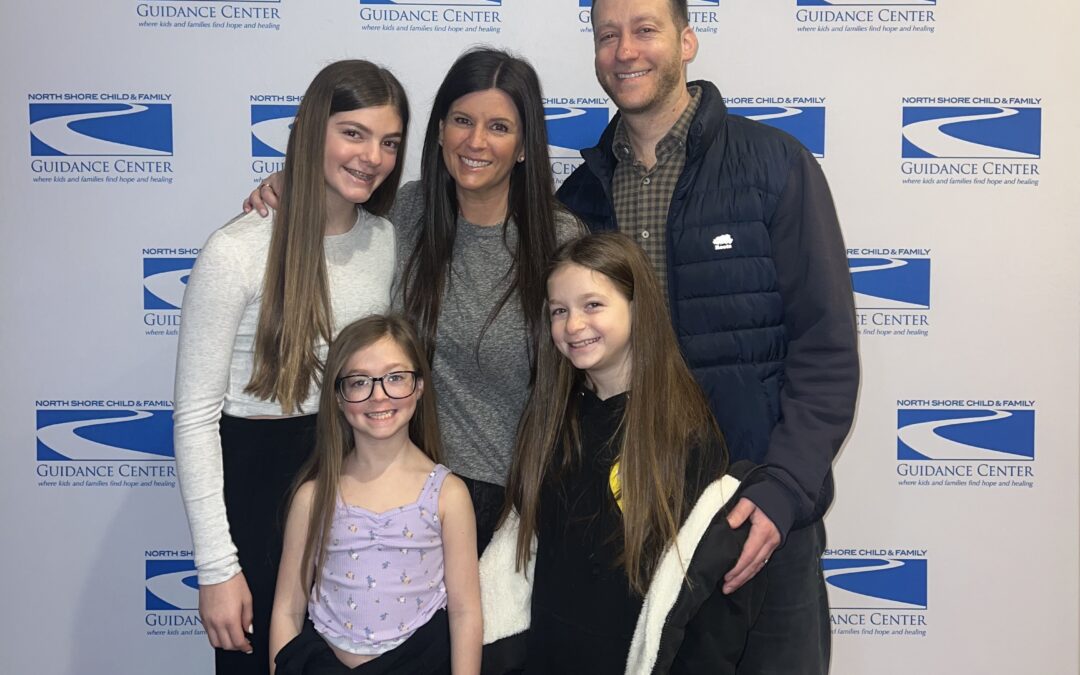
“Morning Movies with the Guidance Center,” North Shore Child & Family Guidance Center’s annual family-friendly fundraiser, brought the community together for an enjoyable morning of popcorn, bagels, drinks, and a choice of three movies: Barbie, Kung Fu Panda 4, and You Are So Not Invited to My Bat Mitzvah.
“We all know that children and teens are experiencing issues like depression, anxiety, and even suicidal thinking more than ever before, and that’s why I’m proud to support the Guidance Center’s lifesaving work,” said Jeffrey Greenblatt, one of the event’s co-chairs and a Guidance Center Board Member. “Plus, my family had a wonderful morning, and I get to set an example for my three daughters. It’s important to me that my children understand the value of serving your community.”
Co-chair Joshua Brookstein, who attended the event with his daughter, said, “It’s always a pleasure to support the mission of the Guidance Center. Ensuring the well-being of our children is crucial, and I’m happy to contribute to efforts in raising funds and awareness for mental health.”
Kathy Rivera, the Guidance Center’s Executive Director/CEO, thanked everyone who came out to support the event, as well as the event’s sponsors: Liberty Utilities, Sahn Ward, Cullen & Dykman LLP, Harris Beach, the Greenblatt Family, and the Slade Family, along with Manhasset Cinemas for generously hosting the event.
“It was an absolute delight spending time with so many children and families to raise awareness about our work while also having fun!” said Rivera.
Click to read The Island Now. Click to read Anton News
by North Shore Child & Family Guidance Center | Mar 28, 2024 | In The Media, LI Herald
The Freeport Memorial Library hosted a detailed, lively panel discussion last Friday, connecting women’s reproductive rights to the New York State Equal Rights Amendment.
The program was organized by the League of Women Voters of Central Nassau.
On Nov. 5, voters will have an opportunity to enshrine a revised version of the state amendment in law, by approving it in the voting booth.
New York currently has an Equal Rights Amendment that prohibits discrimination based on race, color, creed or religion. The revised amendment adds more protected categories: ethnicity, national origin, age, disability and sex.
The category of sex is broken down into “sexual orientation, gender identity, gender expression, pregnancy, pregnancy outcomes, and reproductive health care and autonomy.”
Abortion access may be the issue that most readily comes to mind under the heading “reproductive health care,” but it is not the only concern for women.
Nondiscriminatory treatment before, during and after pregnancy is not uniformly protected throughout the state, nor is government support for children’s health consistent statewide, the panelists said.
Susan Cushman, an English professor at Nassau Community College, defined “reproductive justice” by referring to Loretta Ross, a professor of women and gender studies at Smith College.
Ross named three tenets of reproductive justice: the right not to have a child, which involves abortion access; the right to have as many childrenas a woman may want; and the right to raise children in a healthy environment.
“We need a state constitution that protects your rights and my rights to have the bodily care that we deserve as a basic right,” Cushman said. She referenced a lawsuit, Zurawski v. State of Texas, in which 23 women are suing Texas because they could not obtain abortions that their doctors deemed medically necessary.
Anna Georgoulas, founder of Dovely Doula Services, explained that doulas — non-medical professionals who provide emotional, physical and informational support to new and expectant parents — help fight the high infant and maternal mortality rate in the United States. They help clients create birth plans and train women to advocate for themselves throughout pregnancy, birth and postpartum life. Doulas are “an information hub” for women, Georgoulas said.
Sharon McDermott, a doula whose business is called Healthy Healing, said that New York has instituted ways for birth doula providers to be paid through Medicaid, which increases equitable access for women lacking insurance.
Martine Hackett, an associate professor of health at Hofstra University, related the history of Birth Justice Warriors, which she co-founded with Dr. Nellie Taylor-Walthrust in 2018. Hempstead attorney Frederick K. Brewington lent support by framing the excessive mortality rates among women and infants of color in Nassau County as a civil rights issue.
Pre-existing conditions, like hypertension, are common causes of maternal death, Hackett explained, but a leading cause of infant mortality is stress on the mother during pregnancy.
“We do peer-to-peer education,” Hackett said. “We work with other clinicians, and partner with major health organizations such as Northwell Health to increase health care access.”
“What is happening in Nassau County drove us to action,” Taylor-Walthrust said. “Roosevelt has the highest numbers for infant mortality and low birthweight babies, with Hempstead being number 2 and number 3 being Westbury. We make sure that mother and baby have as healthy an environment as they can, and we teach them that they have a right to ask questions. We educate the hospital doctors and nurses and social workers to treat the mothers with respect.”
Birth Justice Workers has instigated change at the local, state and federal levels. “Women’s maternal health is now being recognized throughout New York state, and in particular in Nassau County, because of the work that Martine and I would not give up on,” Taylor-Walthrust said.
Cushman closed the program by urging voter support for the state Equal Rights Amendment. “For the first time, we are putting reproductive health squarely in the broader framework of protecting all of our rights and freedoms,” she said. “Our coalition is made up of registered Democrats, registered Republicans and independent voters. This is a pan-partisan initiative.”
Deputy Town Supervisor Dorothy Goosby, a member of the League of Women Voters, visited the program and urged attendees to join the organization.
“We need women like you to be involved,” Goosby said, “because it’s the only way we’re going to get things done.
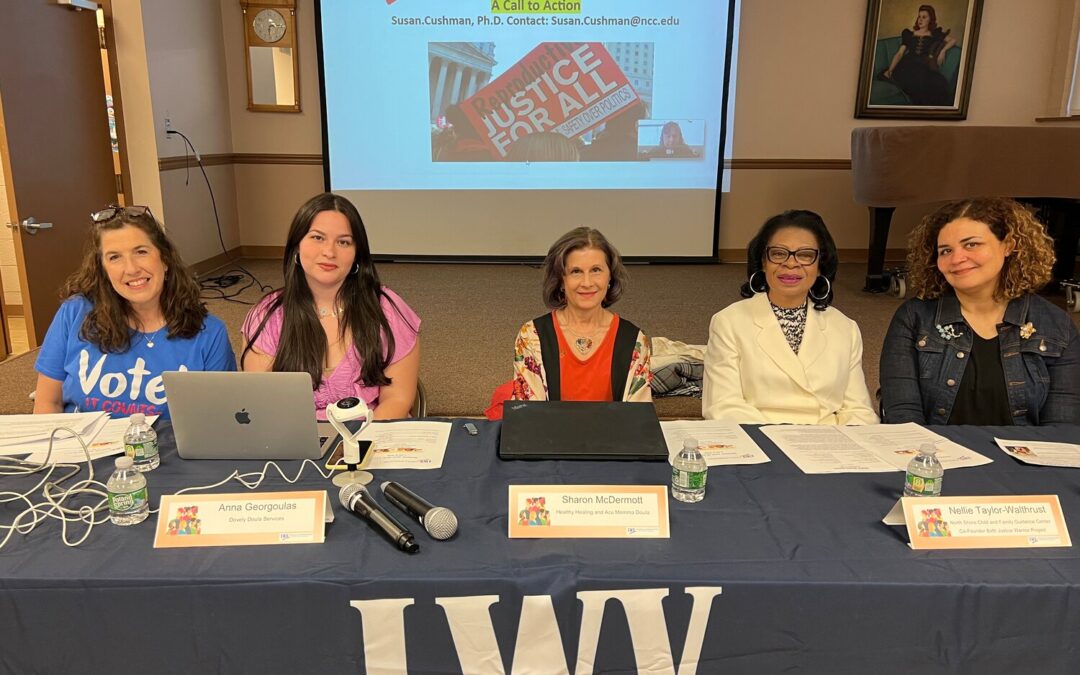
Photo: Panelists at the League of Women Voters of Central Nassau event, hosted by the Freeport Memorial Library last Friday, discussed women’s issues and the state Equal Rights Amendment. From left were Susan Cushman, Anna Georgoulas, Sharon McDermott, Dr. Nellie Taylor-Walthrust, a co-founder of the Birth Justice Warrior Project, and Martine Hackett, an associate professor of health at Hofstra University.
Photo Credit: Courtesy Reine Bethany

by North Shore Child & Family Guidance Center | Mar 22, 2024 | Blog
By Dr. Nellie Taylor-Walthrust
Family court proceedings can have a profound and lasting impact on children, often resulting in emotional and psychological trauma. The adversarial nature of family court, where parents may be pitted against each other in legal battles, can create an environment of stress, uncertainty, and instability for children. As many parents do not have the luxury of leaving their children at home during these disputes, North Shore Child and Family Guidance Center has committed to protecting the children of our community from the long-lasting impact caused by family court.
Why should kids be kept out of court?
While children often do not have the language to make sense of what is happening inside a courtroom, they are highly attuned to the emotions of adults and can pick up on the tension brewing between their parents. Consistent exposure to conflict can weaken a child’s sense of security and contribute to feelings of powerlessness and vulnerability. When left unaddressed, these emotions spiral into depression, anxiety, and insecurities that often follow into adulthood.
Children caught in the midst of their guardians’ legal battle may feel their relationship begin to strain. One of the primary challenges that can arise is the pressure to choose sides, which can emerge from parental expectations, subtle cues, or observed dynamics in the courtroom. It is important to shield kids from these expectations, as picking a side can result in feelings of guilt and abandonment towards the other parent.
As children bear witness to their family undergoing irreparable changes, they often feel a sense of responsibility for the separation. In trying to make sense of the shift in their family, kids frequently end up believing that they are the cause of their parents’ unhappiness. This is especially true in hearings pertaining to custody and child support when the child is the main topic of conversation.
The Children’s Center
The Children’s Center at Nassau County Family Court is operated by North Shore Child and Family Guidance Center. It is a place of respite for children whose families have business in court. Far from a simple babysitting service, the Children’s Center is an early-learning environment that fosters developmental skills through age-appropriate play, activities, and free books for the children to take home. Every aspect of the Children’s Center is designed with kids in mind, allowing them to explore new things in a structured, professionally supervised way. Though they may face uncertainty at home, we are proud to say that the Children’s Center provides a place for kids to be happy, carefree, and most importantly, safe.
To learn more about volunteering at the Children’s Center, contact Dr. Nellie Taylor-Walthrust, Director at North Shore Child & Family Guidance Center’s Leeds Place and head of the Children’s Center, at 516-997-2926, ext. 229, or email ntaylorwalthrust@northshorechildguidance.org.
