
by North Shore Child & Family Guidance Center | Jun 24, 2024 | In The Media, Long Island Business News
Kathy Rivera serves as executive director and CEO for North Shore Child & Family Guidance Center, a children’s mental health organization that focuses on bringing hope and healing to young people struggling with a wide range of emotional challenges.
Rivera, who took on the leadership role at the guidance center in June 2021, has been successfully managing the operations of the agency during the unprecedented mental health crisis that was brought on by the pandemic. Over the last few years, there has been an epidemic of anxiety, depression and fear among children and teens.
Rivera, who earned her Bachelor of Arts from Hunter College of the City University of New York and her Master of Social Work from the Hunter College School of Social Work, has 22 years of experience as a social worker, along with expertise in management. Her deep knowledge of clinical treatment, mental health policy and agency operations provides profound insights and perspective on the ever-changing landscape of mental health.
At North Shore Child & Family Guidance Center, Rivera leads a team of highly trained psychiatrists, psychologists, social workers, alcoholism and substance abuse counselors, mental health counselors, vocational rehabilitation counselors and family advocates, all with expertise and experience in working with children and families. The professionals develop specialized treatment plans for children and their families and employ a team approach to ensure that each child receives appropriate care and is monitored for risk and danger. The guidance center is based in Roslyn Heights, with additional locations in Manhasset and Westbury.

by North Shore Child & Family Guidance Center | Apr 17, 2024 | Anton Community Newspaper, Anton Media, Blog
By Kathy Rivera
Transitioning from school to the job hunt is a daunting yet pivotal phase in the life of every young adult. As your child embarks upon this important journey, they may feel a mixture of excitement, fear, and worry, and not without reason. Job seekers today face more uncertainty than ever, with the latest unemployment rate for young high school graduates falling at 7.9 percent. Recent college graduates fare slightly better with an unemployment rate of 4.8 percent, though this number is nearly double that of all workers with a college degree, according to the Federal Reserve Bank of New York.
As parents, it can be difficult to balance positive reinforcement while managing expectations. Unemployment affects not only the job seeker, but the family unit as a whole, hindering the independence you want for your child. The psychological effects of rejection are amplified the longer the job hunt continues, so it is vital to understand what you can do to best support your child throughout this phase of their life.
Be patient
It’s important for parents to understand that the job market is vastly different today than it was when they were young jobseekers. Gone are the days of walking into a business and handing the owner a resume with the expectation of receiving an interview later that week. Today, candidates can expect to send out dozens, if not hundreds of applications with little to show for it. According to Pew Research Center, 39% of Millennials have a Bachelor’s degree or higher, making them the most educated generation to date, and that number continues to climb with Generation Z. These impressive numbers have created a highly competitive job market, resulting in more college graduates finding themselves in roles that don’t use their degree.
Provide encouragement
After submitting countless applications with nothing to show for it, it’s understandable for your child to feel demoralized or even hopeless. However, it is crucial to motivate your child to continue their search and build upon their skill sets, tailor their resumes to specific jobs, and network with professionals in their field. Remind them that they aren’t alone in feeling discouraged, but that there is a job waiting for them.
Establish healthy coping mechanisms
Constant rejection can be difficult to deal with. Let your child know that it’s okay to experience feelings of sadness, anxiety, and frustration when unemployed, but they shouldn’t let that consume them. Encourage them to take breaks from the application process to relax with friends and loved ones, enjoy their hobbies, and take time away from the computer. Stress-management techniques such as breathing exercises, meditation, and mindfulness will help them through overwhelming feelings during the hunt. Self care is crucial in avoiding burnout when applying for jobs and maintaining strong mental health.
Trust that they know what is best
It makes sense to want updates on how the job search is going, especially if your child is living at home. Despite this, try to refrain from asking for updates too frequently, as this can create further pressure for your child. If they have any promising leads, trust that you will be the first to know. Today’s young adults have a better understanding of the current job market than you may, so allow them to explore their options, make mistakes, and grow on their own.
By adopting these approaches, we can not only help our children overcome the burden of unemployment but help them to foster the independence and resilience needed to thrive in a professional landscape, all while maintaining their mental well-being.
by North Shore Child & Family Guidance Center | Apr 3, 2024 | In The Media, Press Releases, The Island Now
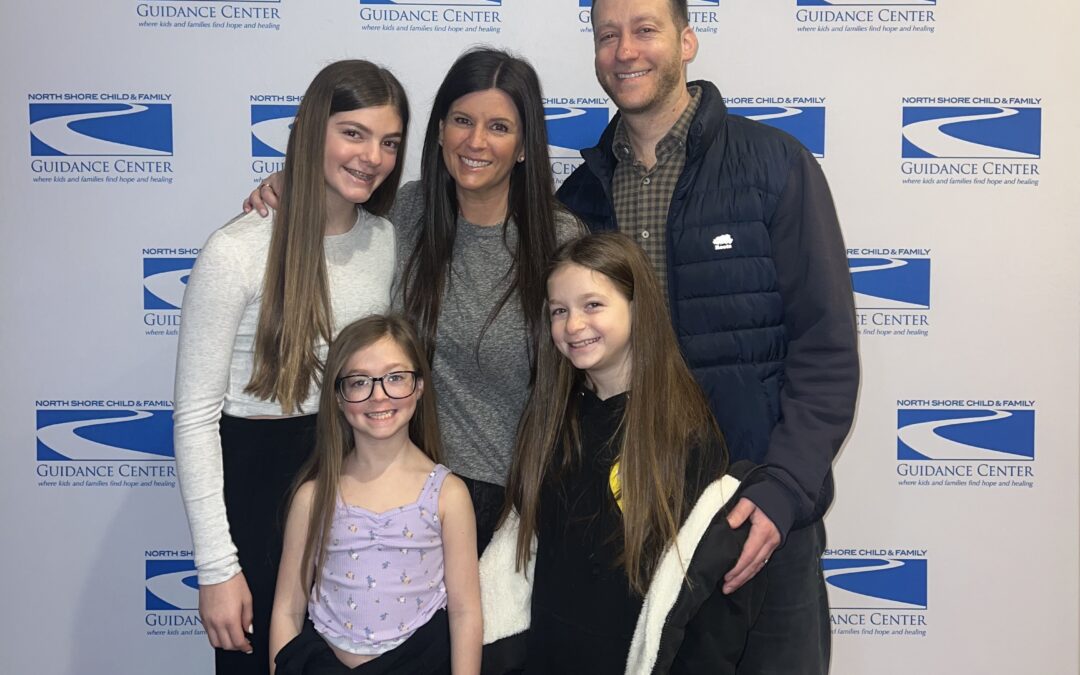
“Morning Movies with the Guidance Center,” North Shore Child & Family Guidance Center’s annual family-friendly fundraiser, brought the community together for an enjoyable morning of popcorn, bagels, drinks, and a choice of three movies: Barbie, Kung Fu Panda 4, and You Are So Not Invited to My Bat Mitzvah.
“We all know that children and teens are experiencing issues like depression, anxiety, and even suicidal thinking more than ever before, and that’s why I’m proud to support the Guidance Center’s lifesaving work,” said Jeffrey Greenblatt, one of the event’s co-chairs and a Guidance Center Board Member. “Plus, my family had a wonderful morning, and I get to set an example for my three daughters. It’s important to me that my children understand the value of serving your community.”
Co-chair Joshua Brookstein, who attended the event with his daughter, said, “It’s always a pleasure to support the mission of the Guidance Center. Ensuring the well-being of our children is crucial, and I’m happy to contribute to efforts in raising funds and awareness for mental health.”
Kathy Rivera, the Guidance Center’s Executive Director/CEO, thanked everyone who came out to support the event, as well as the event’s sponsors: Liberty Utilities, Sahn Ward, Cullen & Dykman LLP, Harris Beach, the Greenblatt Family, and the Slade Family, along with Manhasset Cinemas for generously hosting the event.
“It was an absolute delight spending time with so many children and families to raise awareness about our work while also having fun!” said Rivera.
Click to read The Island Now. Click to read Anton News
by North Shore Child & Family Guidance Center | Mar 28, 2024 | In The Media, LI Herald
The Freeport Memorial Library hosted a detailed, lively panel discussion last Friday, connecting women’s reproductive rights to the New York State Equal Rights Amendment.
The program was organized by the League of Women Voters of Central Nassau.
On Nov. 5, voters will have an opportunity to enshrine a revised version of the state amendment in law, by approving it in the voting booth.
New York currently has an Equal Rights Amendment that prohibits discrimination based on race, color, creed or religion. The revised amendment adds more protected categories: ethnicity, national origin, age, disability and sex.
The category of sex is broken down into “sexual orientation, gender identity, gender expression, pregnancy, pregnancy outcomes, and reproductive health care and autonomy.”
Abortion access may be the issue that most readily comes to mind under the heading “reproductive health care,” but it is not the only concern for women.
Nondiscriminatory treatment before, during and after pregnancy is not uniformly protected throughout the state, nor is government support for children’s health consistent statewide, the panelists said.
Susan Cushman, an English professor at Nassau Community College, defined “reproductive justice” by referring to Loretta Ross, a professor of women and gender studies at Smith College.
Ross named three tenets of reproductive justice: the right not to have a child, which involves abortion access; the right to have as many childrenas a woman may want; and the right to raise children in a healthy environment.
“We need a state constitution that protects your rights and my rights to have the bodily care that we deserve as a basic right,” Cushman said. She referenced a lawsuit, Zurawski v. State of Texas, in which 23 women are suing Texas because they could not obtain abortions that their doctors deemed medically necessary.
Anna Georgoulas, founder of Dovely Doula Services, explained that doulas — non-medical professionals who provide emotional, physical and informational support to new and expectant parents — help fight the high infant and maternal mortality rate in the United States. They help clients create birth plans and train women to advocate for themselves throughout pregnancy, birth and postpartum life. Doulas are “an information hub” for women, Georgoulas said.
Sharon McDermott, a doula whose business is called Healthy Healing, said that New York has instituted ways for birth doula providers to be paid through Medicaid, which increases equitable access for women lacking insurance.
Martine Hackett, an associate professor of health at Hofstra University, related the history of Birth Justice Warriors, which she co-founded with Dr. Nellie Taylor-Walthrust in 2018. Hempstead attorney Frederick K. Brewington lent support by framing the excessive mortality rates among women and infants of color in Nassau County as a civil rights issue.
Pre-existing conditions, like hypertension, are common causes of maternal death, Hackett explained, but a leading cause of infant mortality is stress on the mother during pregnancy.
“We do peer-to-peer education,” Hackett said. “We work with other clinicians, and partner with major health organizations such as Northwell Health to increase health care access.”
“What is happening in Nassau County drove us to action,” Taylor-Walthrust said. “Roosevelt has the highest numbers for infant mortality and low birthweight babies, with Hempstead being number 2 and number 3 being Westbury. We make sure that mother and baby have as healthy an environment as they can, and we teach them that they have a right to ask questions. We educate the hospital doctors and nurses and social workers to treat the mothers with respect.”
Birth Justice Workers has instigated change at the local, state and federal levels. “Women’s maternal health is now being recognized throughout New York state, and in particular in Nassau County, because of the work that Martine and I would not give up on,” Taylor-Walthrust said.
Cushman closed the program by urging voter support for the state Equal Rights Amendment. “For the first time, we are putting reproductive health squarely in the broader framework of protecting all of our rights and freedoms,” she said. “Our coalition is made up of registered Democrats, registered Republicans and independent voters. This is a pan-partisan initiative.”
Deputy Town Supervisor Dorothy Goosby, a member of the League of Women Voters, visited the program and urged attendees to join the organization.
“We need women like you to be involved,” Goosby said, “because it’s the only way we’re going to get things done.
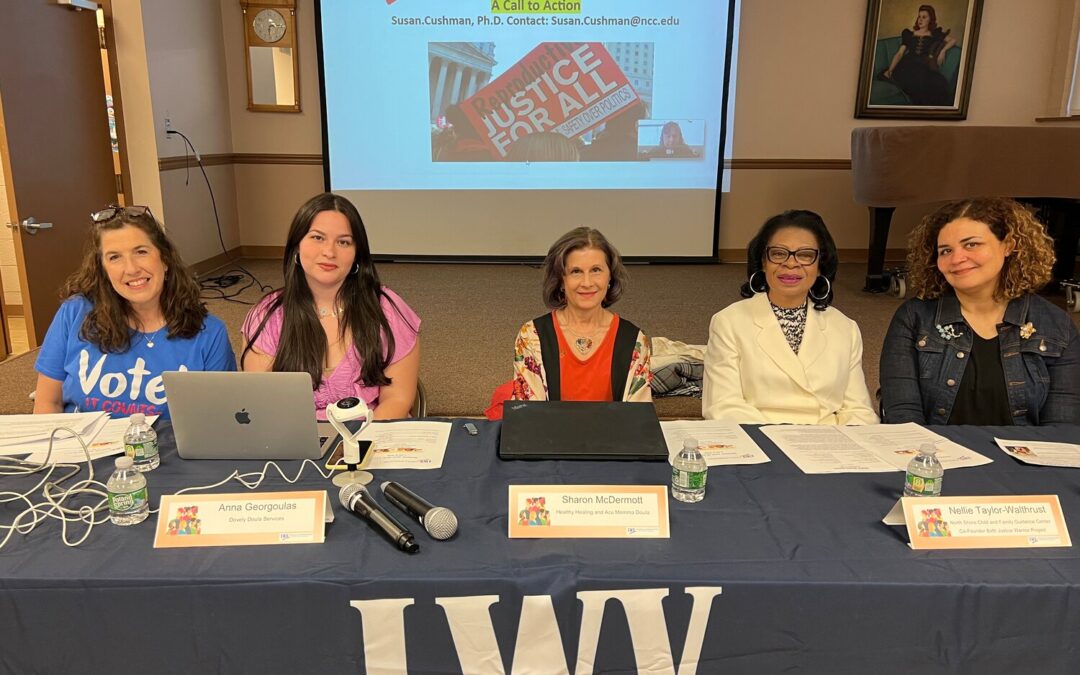
Photo: Panelists at the League of Women Voters of Central Nassau event, hosted by the Freeport Memorial Library last Friday, discussed women’s issues and the state Equal Rights Amendment. From left were Susan Cushman, Anna Georgoulas, Sharon McDermott, Dr. Nellie Taylor-Walthrust, a co-founder of the Birth Justice Warrior Project, and Martine Hackett, an associate professor of health at Hofstra University.
Photo Credit: Courtesy Reine Bethany
by North Shore Child & Family Guidance Center | Mar 15, 2024 | Anton Media, Blank Slate Media, In The Media, Long Island Business News, Press Releases
North Shore Child & Family Guidance Center, Long Island’s leading not-for-profit children’s mental health center, is honored to announce that The Marilyn Lichtman Foundation has donated $10,000 towards supporting the Children’s Center at Nassau County Family Court.
The Children’s Center at Nassau Family Court is a program of North Shore Child and Family Guidance Center that offers a place of respite for children whose families have business in court. More than a babysitting service, the Children’s Center is an early-learning environment that fosters developmental skills through age-appropriate play, activities, and free books for the children to take home. Every aspect of the Children’s Center is designed with kids in mind, allowing them to explore new things in a structured, professionally supervised way.
“Many of the organizations we support involve children in many different situations,” said Robert Brull, President of the Marilyn Lichtman Foundation. “As a former investigator, I’ve seen what trauma can fall upon children from court cases, especially cases involving divorce and/or child abuse. Giving a child the ability to feel safe and comfortable while parents or guardians go through the court’s justice system is a positive step in reducing emotional damage to the child.”
Dr. Nellie Taylor-Walthrust, Director of the Leeds Place — Serving Young People, expressed immense gratitude towards the Marilyn Lichtman Foundation’s generous donation. “Our goal at the Children’s Center is to keep kids out of the courtroom and provide a safe place for them to grow,” said Dr. Taylor-Walthrust. “The Center is free for any family with business at Nassau County Family Court, so this grant will allow us to continue and expand upon this important program. Thank you to Robert and the Marilyn Lichtman Foundation for caring about our children.”
The Marilyn Lichtman Foundation honors the legacy of Marilyn Lichtman through philanthropic contributions to those in need throughout our community, hoping to enhance the lives of future generations.
For more information on the Marilyn Lichtman Foundation, visit marilynlichtmanfoundation.org. To learn more about the Guidance Center, visit www.northshorechildguidance.org or call 516-626-1971.
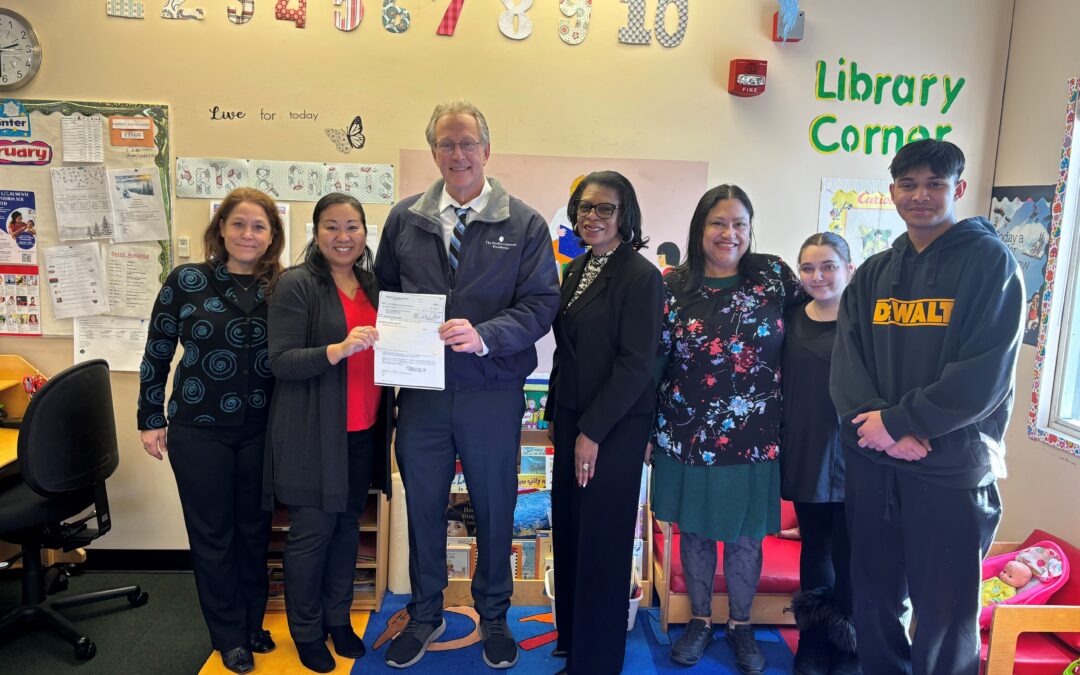
Pictured: Lauren McGowan, Kathy Rivera, Robert Brull, Dr. Nellie Taylor-Walthrust, Monica Dolley, and volunteers Ashley Gentiluomo & Alex Breslin
Published in Anton Media, click to view, Blank Slate, click to view, and Long Island Business News, click to view.
by North Shore Child & Family Guidance Center | Feb 16, 2024 | In The Media, Press Releases
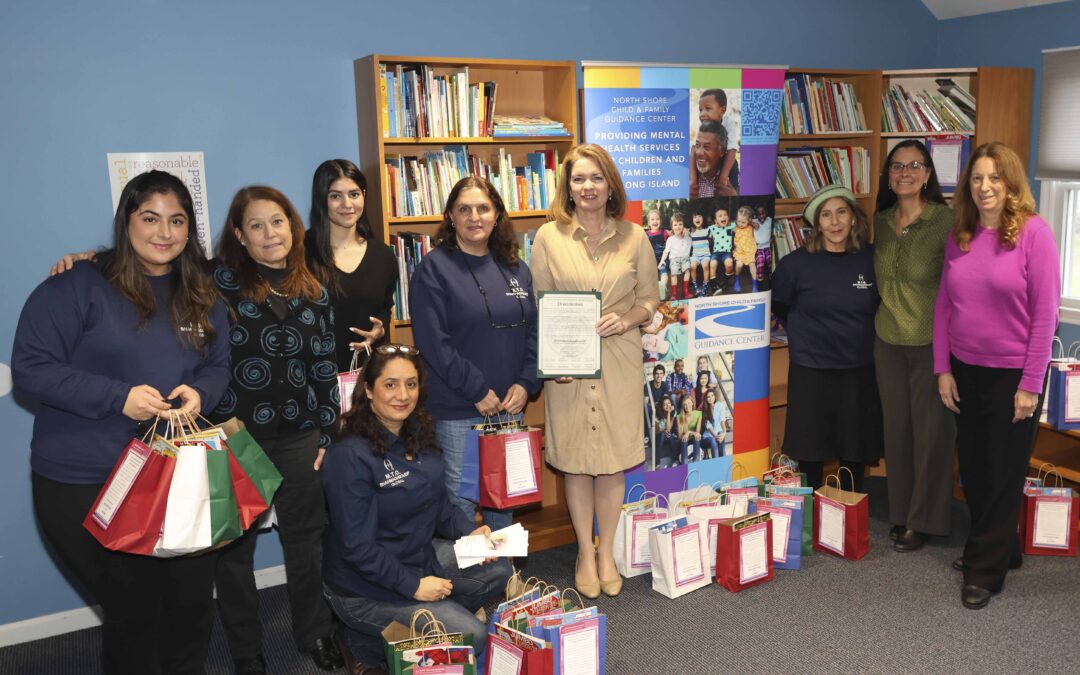
January 24, 2024, Manhasset – To celebrate International Day of Education, MTO Shahmaghsoudi School of Islamic Sufism rallied the community to donate art and early learning supplies for the children of North Shore Child & Family Guidance Center. Dozens of gift bags were donated and distributed to the young clients of the Guidance Center’s Manhasset location, the Marks Family Right from the Start Center 0-3+, providing an outlet for kids to use art and creativity as a way to strengthen their mental well-being.
“The donation represents our collective effort to come together and spread the message of peace, love, and hope,” said MTO volunteer Ellica Sedigh. “MTO Professor Nader Angha, the current Sufi Master, has said that “hope is a planted seed in fertile ground that bears fruit.” Through these gift bags we symbolize the act of planting seeds of hope for children facing mental health challenges.”
Dr. Sue Cohen, the Director of Clinical Services at the Marks Family Right from the Start Center 0-3+, shared that the gift bags were greatly appreciated by the Guidance Center’s clients and their parents. “The goodies in the bags align with the work that we do on finding appropriate activities to use as coping mechanisms and grounding skills,” she said.
Town of Hempstead Supervisor Jennifer DeSena, a longtime supporter of both North Shore Child & Family Guidance Center and MTO Shahmaghsoudi, stated “Mental health is something I have worked to promote and educate about for many years. MTO and the Guidance Center both share a devotion to mental health and finding balance in positive ways through serving and educating the community.”
About Us:
As the preeminent not-for-profit children’s mental health agency on Long Island, North Shore Child & Family Guidance Center is dedicated to restoring and strengthening the emotional well-being of children (from birth – age 24) and their families. Our highly trained staff of psychiatrists, psychologists, social workers, vocational rehabilitation counselors and other mental health professionals lead the way in diagnosis, treatment, prevention, training, parent education, research, and advocacy. The Guidance Center helps children and families address issues such as depression and anxiety; developmental delays; bullying; teen pregnancy; sexual abuse; teen drug and alcohol abuse; and family crises stemming from illness, death, trauma, and divorce. For nearly 70 years, the Guidance Center has been a place of hope and healing, providing innovative and compassionate treatment to all who enter our doors, regardless of their ability to pay. For more information about the Guidance Center, visit www.northshorechildguidance.org or call (516) 626-1971.
by North Shore Child & Family Guidance Center | Feb 1, 2024 | Blank Slate Media, In The Media
Published in Blank Slate Media on January 24th, 2024
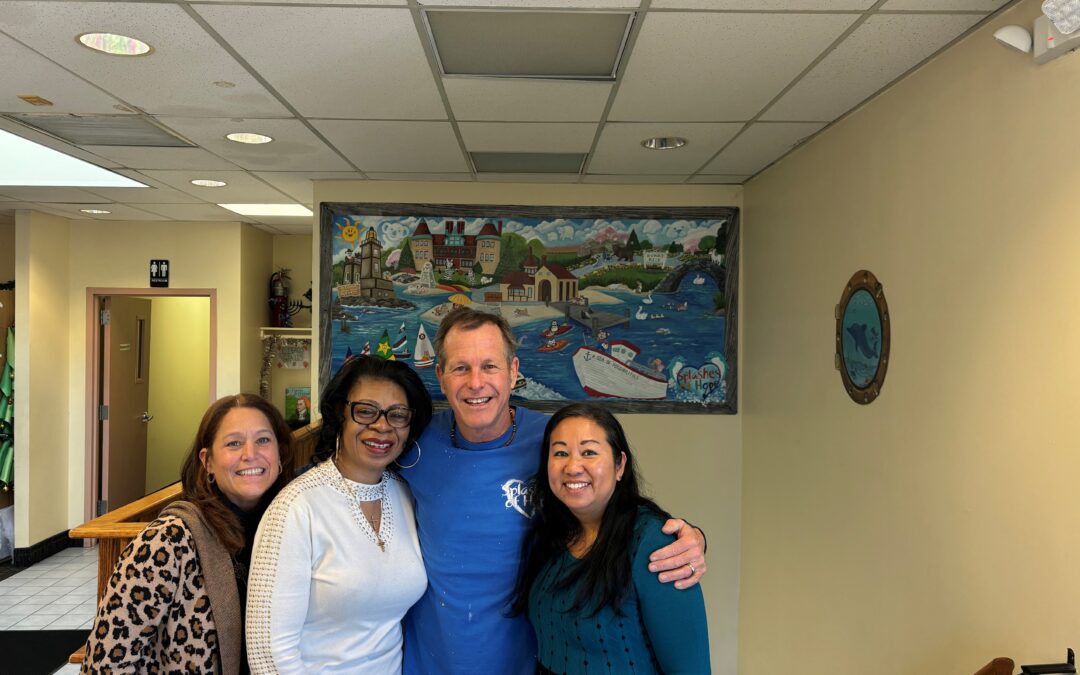
The walls of North Shore Child and Family Guidance Center look a lot brighter thanks to the wonderful murals donated by Splashes of Hope. The nonprofit organization, dedicated to transforming environments “from clinical to colorful,” paid a visit to The
Leed’s Place — Serving Young People on December 20th with the intention of bringing warmth and cheer to the space. The Leed’s Place is home to a variety of specialized services benefiting the youth of Nassau County, including programs for pregnant & parenting teens and adolescents struggling with alcohol & substance dependency. Clients are now greeted by an expansive mural depicting “A Sea of Possibilities,” instilling hope in all who walk through the doors.
“Splashes of Hope has transformed our waiting areas into a welcoming, eye-catching, and positive environment for our patients and staff,” says Dr. Nellie Taylor-Walthrust, Director of The Leed’s Place. “It’s exciting to see children and their families closely examining the custom mural, pointing out the various details they find interesting and exciting. The art has brought an exciting new life to The Leeds Place.”
“After meeting the staff at North Shore Child & Family Guidance Center and learning about their mission, we measured and assessed The Leeds Place and couldn’t wait to make a ‘splash’,” said Heather J. Buggee, Founder and CEO of Splashes of Hope. “To serve as a reflection of the positive energy, care and concern this staff exemplifies, Splashes of Hope created uplifting, thoughtful murals and focal points for families who enter North Shore Child & Family Guidance Center. We are grateful to have this important resource for children and families in crisis. Our intention is for the artwork to transform the space into a welcoming and uplifting environment.”
Laurence W. Levine Foundation, a longtime supporter of Splashes of Hope’s work, made the beautification of The Leed’s Place possible. “The Levine Foundation is well aware of the importance of mental health awareness and treatment for children and their families,” said Lesley Logue, a Director of the Levine Foundation. “Splashes of Hope transcends a once-dull space into a peaceful, calming backdrop to elicit a therapeutic response in a place like the Guidance Center. The designs, artistry and colors used can transform not only the walls, but the whole process for everyone who enters! Our hope is to continue supporting Heather and all of Splashes of Hope as they bring comfort to those who are facing difficult times, splashing away some of the darkness by bringing more color to their lives.”
Thank you so much to Laurence W. Levine Foundation and Splashes of Hope for making this special project a reality!
Photo: Lauren McGowan, Dr. Nellie Taylor-Walthrust, Jim Knapp, Kathy Rivera
Click here to read the article.
by North Shore Child & Family Guidance Center | Dec 3, 2023 | In The Media, Press Releases
Published in Port Washington News on November 15, 2023
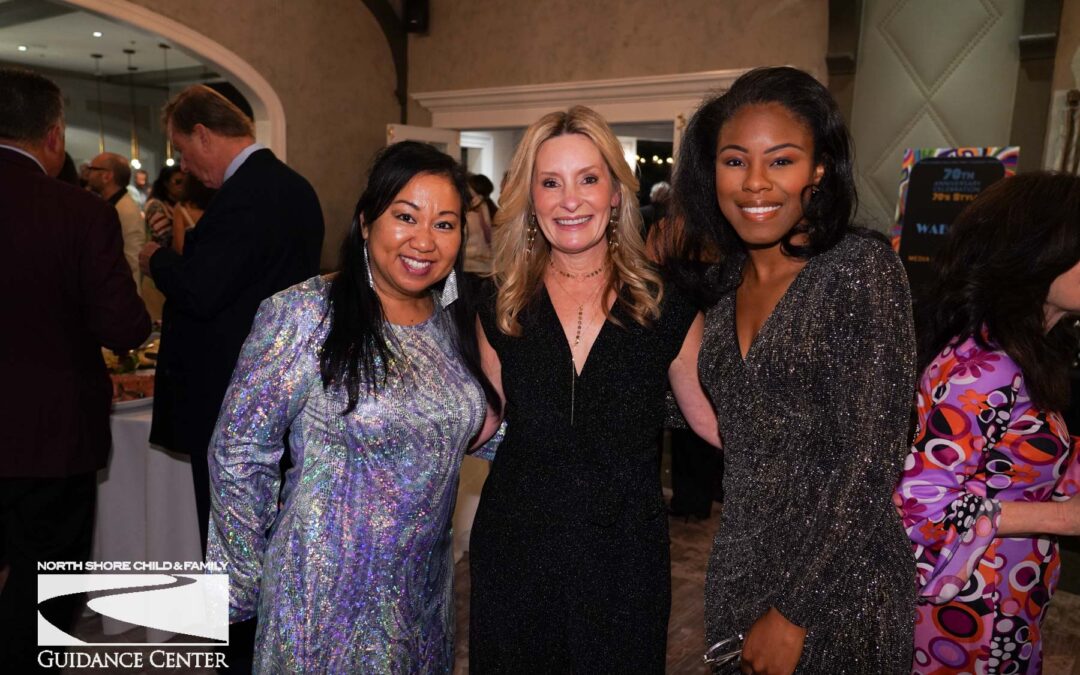
It was a night to remember at North Shore Child & Family Guidance Center’s 70th Anniversary Celebration in 70s Style, held on October 26, 2023 at North Hempstead Country Club. The event raised over $230,000 to support the Guidance Center, Long Island’s premier nonprofit children’s mental health organization.
The evening’s music was provided by Peat Moss and the Fertilizers, who filled the air with a variety of disco and boogie hits from the 70s, staying true to the event’s theme and keeping guests on the dance floor throughout the night.
Carol Bottiglieri, the mother of a long-time Guidance Center client shared an emotional account of her son’s struggle with depression, anxiety, and substance use. “Without North Shore Child & Family Guidance Center, our family would be broken today,” she shared with the audience. “Because of the therapy and support given to us by the Guidance Center, we remain a strong, united family, continuing to help my son achieve a healthy, happy, independent life.” Carol’s story brought guests to tears and received a standing ovation.
Guidance Center Executive Director/CEO Kathy Rivera proudly honored the rich history of the organization she now leads, which spans seven decades. “I stand on the shoulders of giants and would not be speaking to you all tonight without their invaluable contributions.” she said of her predecessors. “The reason we have been able to bring hope and healing to the community for 70 years is thanks to them, and to all of you who support our mission.”
Rivera also thanked the night’s emcee, Crystal Cranmore of Channel 7 Eyewitness News, as well as the sponsors and underwriters of the event: the Klipper Family Foundation; Americana Manhasset, the Jane & Martin Schwartz Family Foundation; the Jack & Dorothy Kupferberg Family Foundation; Maureen & John Ferrari; Andrea & Michael Leeds; and WABC.
Guidance Center Board President Alexis Siegel acknowledged the sad tragedies occurring throughout the world and thanked the Guidance Center for helping members of the community receive the emotional support needed. “Though we can’t change the atrocities that are happening around us, we do have a say in how we choose to respond,” she said. “The Center is a lifeline to so many families struggling to find peace and a way forward through the darkness.”
by North Shore Child & Family Guidance Center | Dec 3, 2023 | In The Media, Newsday
By Tiffany Cusaac-Smith, Published in Newsday, October 21, 2023
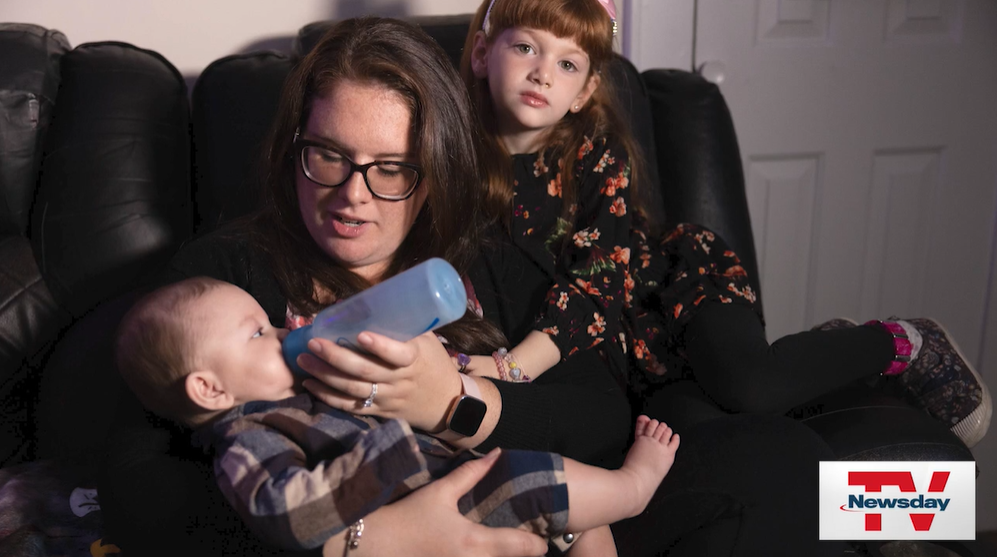
After giving birth to her son in March, Justine Hofsiss lay in the fetal position on a couch at her Franklin Square home unable to function.
Ringing in her ears, heart palpitations, sweating, shaking — those were among the symptoms she shared with her best friend, a nurse, who tried to provide remedies until realizing the salve might be mental health treatment.
“It was a very scary, very overwhelming time in my life, where I felt like I had no control of my body whatsoever,” said the mother of two who had already eschewed driving because of her emotions.
With a referral from the friend, Hofsiss in April turned to the North Shore Child & Family Guidance Center, crying in an intake call but finally hearing a voice to help make sense of her feelings after a traumatic birth and pregnancy.
“I hung up the phone and just cried because I’m like, ‘OK, this isn’t going to be forever. I’m going to be OK. I’m gonna get help,’” she said.
The North Shore Child & Family Guidance Center’s maternal health and wellness program is among a handful of places on Long Island working to treat pregnant people and those who have recently given birth for mental health issues such as anxiety or perinatal depression, which is common but can impact a woman’s ability to function — and even be life-threatening.
Roughly one in eight women in the United States said they experienced symptoms of postpartum depression since the birth of their babies, according to the Centers for Disease Control and Prevention.
Mental health conditions are the leading cause of pregnancy-related deaths, the CDC said, citing data from 2017 to 2019. That figure includes suicides and overdoses related to substance use.
In New York, mental health issues made up 15% of pregnancy-related deaths in 2018, or the third-leading cause, the state Department of Health said.
The overall number of women in the state who asked for help for depression after giving birth has steadily increased from 2017 to 2020, moving from 7.7% to 11.3%, the Department of Health said.
Meanwhile, the number of women who said a health care provider had asked them about depression symptoms at a postpartum visit moved from 76.1% in 2016 to 82.4% in 2020, the DOH said.
Childbearing is often perceived as a joyous moment, but it is also a moment of immense physical and emotional change that can leave people in anguish, experts say.
“The expectation is this should be such a wonderful point in your life,” said Dr. Sue Cohen, clinical psychologist and a clinical director at the center.
She later added: “Everyone, maybe their parents say to them, ‘Oh, you should feel so grateful you have a healthy child,’ but they’re not feeling it.”
Barriers to getting mental health care
And while in the throes of mental health ailments, many women also face barriers to getting care, including the stigma of such illness and long waits to see providers, said Dr. Brittain Mahaffey, a licensed clinical psychologist and director of the Dialectical Behavior Therapy at Stony Brook Medicine.
In addition, some psychiatrists will not prescribe medication to people who are pregnant or breastfeeding out of fear of harming the child. Other times, women will forgo their prescriptions while pregnant.
The North Shore Child & Family Guidance Center maternal program seeks to be a bridge for women seeking care, taking referrals from OB/GYNs, pediatricians and word-of-mouth.
They then do a screening call to ensure the women don’t need to be taken to a hospital. Within a week of that call, the parent is seen.
“We treat it like an emergency because these moms are at risk, and the babies could be at risk,” said Cohen, later noting: “We need to make sure everyone’s safe.”
Cohen said many of the program’s clients have had a traumatic birthing experience. A depressive or anxious history is sometimes the case.
The patients go into individual therapy or with a partner. A staff psychiatrist works to provide care for women who are pregnant or have just given birth. Parents can bring their children if they come in for visits, as evidenced by the toys and children’s artwork in the offices.
The sessions usually take place over a year but can last longer.
“Some women just need a little support to get through this period and you know, are grateful that they’ve gotten this, and they can go back to their level of functioning,” Cohen said.
Anxiety after difficult delivery
While pregnant with her son, Hofsiss was hospitalized multiple times because her blood pressure spiked. During delivery, the baby’s heart rate dipped, and she was given oxygen.
After the birth, she stayed in the hospital for a week — away from her daughter, 5, and unable to adjust to everyday life.
“I had a full-blown anxiety attack because I was afraid that my blood pressure was not going to get better. It was constantly going to be high. I was never going to go home. We have this new baby now, we need to get adjusted. And my anxiety just got bigger and bigger.”
She reached out to the North Shore Child & Family Guidance Center, where she was diagnosed with postpartum depression and anxiety.
There, she met a therapist who gave her strategies to promote her care and mindfulness. One of the tools that she holds close is the idea of kintsugi. The Japanese technique mends broken pieces of pottery but still shows the seams, demonstrating both beauty, imperfections and endurance.
“It’s a different version of what you were, but it’s going to be a better version. And it’s OK that it’s different than what you were used to,” said Hofsiss, who is also on medication.
Mahaffey said the stress that mothers experience before they become a parent is one of the most important predictors of depression and anxiety.
Young parents may have more stress because of financial difficulties and mothers who have had a traumatic pregnancy could be also more prone to anxiety.
“I want people to know that mental health problems don’t just magically start in the postpartum; it usually starts during pregnancy and then worsens into the postpartum,” she said.
Depression deepens during pregnancy
After struggling to get pregnant, Dhipinder Walia said she felt “embarrassed” when depression crept back up while she was pregnant.
“I always just sort of felt like something was wrong with me because it is something I was asking for. So why, why couldn’t I just figure it out?”
Walia, 35, of Lynbrook, eventually told her OB/GYN that she was depressed, only for her to be given providers who had a long waiting list.
Meanwhile, she said, her feelings of depression were stronger and deeper than when she was a teen and in her 20s.
“Whereas before I just felt like I was unable to, like, find joy in things and like, I just needed help and getting there,” she said. But this time, “it was like, physical and mental pain.”
She got mental health care only after her child was born, after she mentioned her feelings to the child’s pediatrician, who called a social worker and put her in contact with the program.
Once in therapy, Walia said she learned how not to lean into distorted thoughts or how to set herself up for a good cry when she was feeling weepy.
By 18 months into therapy, she had better structures in place, aiding her overall health and giving her a clearer sense of her purpose.
“My purpose is to, you know, be a good mom and to support folks who need support,” she said. “But, I also feel like I’ve gained a lot of confidence and … understanding — all these abilities that I didn’t ever think I could have.”

by North Shore Child & Family Guidance Center | Dec 1, 2023 | Anton Media, Blog, In The Media
By Kathy Rivera, Executive Director/CEO, North Shore Child & Family Guidance Center
Children are always listening, even to things they may not have the ability to fully comprehend. Whether it be from social media, school, or adults in their lives, it’s inevitable that kids are hearing about the many tragedies that are occurring throughout the world today. Though a parent’s first instinct may be to shield their child from the anxiety and fear that comes with the unknown, avoiding the topic could leave their child feeling lost and helpless.
Discussing challenging world events with your children is a delicate but necessary task. By fostering trust, maintaining composure, promoting open communication, addressing social media influence, and helping children cope with anxiety, you can guide them through the complexities of the world while providing them with a safe and supportive environment. These conversations should be ongoing and adapted to your child’s age and maturity level as they grow and develop.
A foundation of trust
Children need to know that they can rely on their parents through hard times. It’s important to have a strong foundation of trust before going into any difficult conversation with your child. So, what’s the best way to do this? Dr. Sue Cohen, Director of Early Childhood and Psychological Services at North Shore Child & Family Guidance Center, highlights the importance of actively listening to your children. By paying attention to what they say, encouraging family conversations, and demonstrating mutual respect, you can build a strong foundation of trust. This is vital in helping your children navigate complex issues and challenges in the world.
Remain calm
Before explaining the news to children, it’s essential for parents to come to terms with it themselves. Kids are adept at picking up on adult emotions, often feeling affected by the stress, anger, and anxiety of their caregivers, so remaining composed while approaching the topic is crucial for effective communication. “Children feed into their parents’ tone, so if they give the information in a calm manner, children will know that they’re safe,” says Dr. Cohen.
Open communication
Parents should strive to understand what their children already know to gauge their exposure to external information. Get a sense of their awareness and correct any misinformation they may have encountered. Allow them to ask questions without judgment and answer them in an age-appropriate manner. For younger kids, assure them that the scary events are happening far away and that they are safe. For older children, stress the importance of finding reliable information on current events and knowing when to look away from the news.
Addressing social media
With the rise of technology and social media, kids today have unfiltered access to events happening anywhere in the world. What once could only be viewed on the nightly news or in the morning paper is now at our children’s fingertips 24/7. It is important to explain to tweens and teenagers the realities of social media. Anyone can have a platform on sites like TikTok and Instagram, which means that not everything they see is backed up by facts. Media literacy is taught in some schools, but it’s important to continue those lessons at home. Discuss the importance of finding primary sources, understanding biases, and recognizing historical context.
Dealing with anxiety
Exposure to tragic events can significantly increase anxiety levels in children, impacting their daily routine, sleep schedules, and eating habits. Dr. Cohen emphasizes the importance of maintaining regular routines, as children thrive on consistency. Encourage children to express their feelings through creative outlets like artwork and music, or by seeking support from a youth group or volunteer service. Staying mentally and physically active can significantly impact how children cope with distressing news.
Remember that support is there for your families as we all navigate this difficult time. Contact the North Shore Child & Family Guidance Center at 516-626-1971 if you or a loved one are struggling.
by North Shore Child & Family Guidance Center | May 16, 2023 | In The Media, Press Releases
Roslyn Heights, NY, May 10, 2023—On Thursday, April 28, 2023, a sellout crowd of over 250 participants came together for North Shore Child & Family Guidance Center’s Annual Spring Luncheon. This year’s event, which supports the Guidance Center’s mission to restore and strengthen the emotional well-being of children and their families, garnered a record-breaking $100,000 in donations.
The gathering at Glenn Head Country Club started with a morning session of Mahjong and Canasta accompanied by exclusive shopping experiences from several of Long Island’s most fashionable and philanthropic small businesses including: Ameliora, Chintz Giraffe, Daniella Erin NYC, Dash Accessories, DeCorr & More, Designs that Donate, Eye Candy, Freida Rothman Jewelry, Kostume Klassics, Meryl Roesch Sunglasses, Simply Splendid Accessories, Tall Order, and Transitions.
After an elegant buffet lunch, event co-chair, Alexis Siegel, introduced the day’s speaker, Lisa Friedman Clark. The crowd was moved and enlivened by Ms. Clark’s inspirational story of overcoming considerable personal tragedy to become an advocate for mental health services and co-owner of the apparel company Tall Order.
“Lisa Friedman Clark’s story is remarkably moving,” said Alexis Siegel “Her continued strength, motivation, and resilience in the face of so much adversity is inspirational. Hearing about how the Guidance Center’s dedicated team of professionals played such a critical role in her family’s healing process makes me proud to be a part of this organization.”
The luncheon wouldn’t have been such a triumph without the hard work of the co-chairs, Jan Ashley, Amy Cantor and Alexis Siegel. “I am so grateful to everyone who participated in our Spring Luncheon event,” said Kathy Rivera Executive Director of the Guidance Center. “Together we are making our Long Island communities stronger by raising awareness and supporting our mission.”
The Guidance Center is also grateful for the support of its sponsors. They are: Americana Manhasset,
Amy Cantor, Alexis Siegel, Joan Grant, Klipper Family Foundation, NYU Langone Hospital – Long Island,
United Healthcare, Ruth Fortunoff Cooper, Nancy Lane, South Oaks Hospital and Zucker Hillside Hospital – Northwell Health, Marilyn Albanese, Janice Ashley, Stephanie Ginsberg, Janni and Associates, Andrea Leeds, Fara Copell, Stacy Hoffman, Debbie Klein, Cynthia Rubinberg, Janice Schlesinger, Joanne Silverman and Rachel Zuckerbrot.

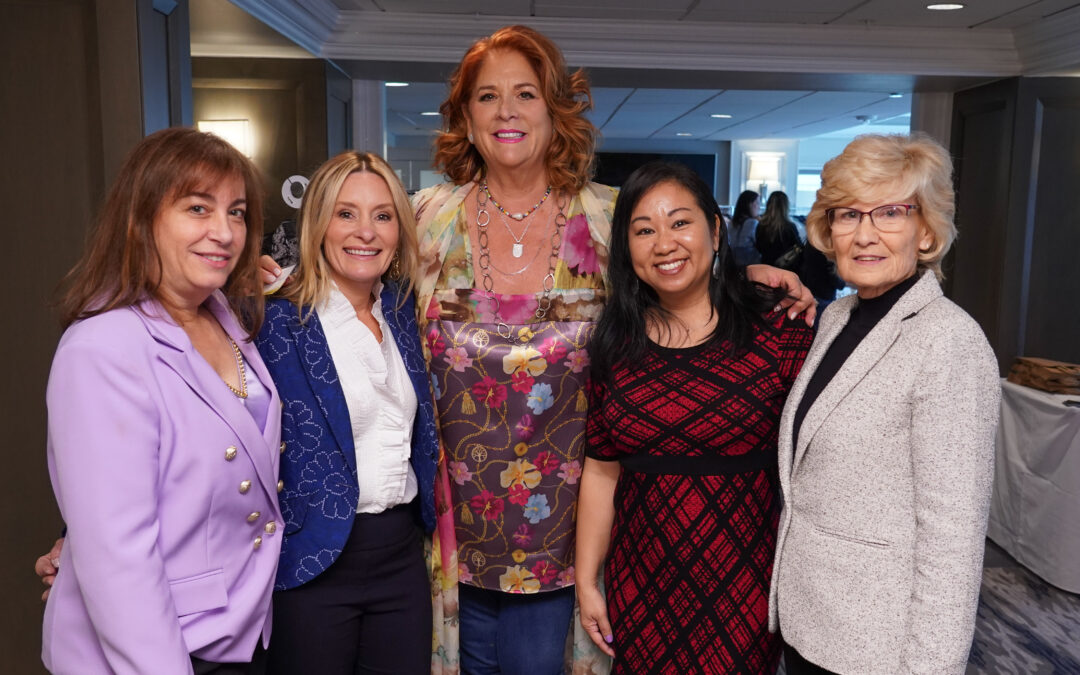
Pictured from left: Michele Frankel, Andrea Leeds, Faith Lerner, and Michele Freidus
Feature Photo: pictured from left: Amy Cantor, Kathy Rivera, Alexis Siegel, Lisa Friedman Clark
About Us:
As the preeminent not-for-profit children’s mental health agency on Long Island, North Shore Child & Family Guidance Center is dedicated to restoring and strengthening the emotional well-being of children (from birth – age 24) and their families. Our highly trained staff of psychiatrists, psychologists, social workers, vocational rehabilitation counselors and other mental health professionals lead the way in diagnosis, treatment, prevention, training, parent education, research and advocacy. The Guidance Center helps children and families address issues such as depression and anxiety; developmental delays; bullying; teen pregnancy; sexual abuse; teen drug and alcohol abuse; and family crises stemming from illness, death, trauma and divorce. For more than 65 years, the Guidance Center has been a place of hope and healing, providing innovative and compassionate treatment to all who enter our doors, regardless of their ability to pay. For more information about the Guidance Center, visit www.northshorechildguidance.org or call (516) 626-1971.
by North Shore Child & Family Guidance Center | Mar 13, 2023 | CBS News TV, In The Media

by North Shore Child & Family Guidance Center | Mar 10, 2023 | In The Media, The Island Now
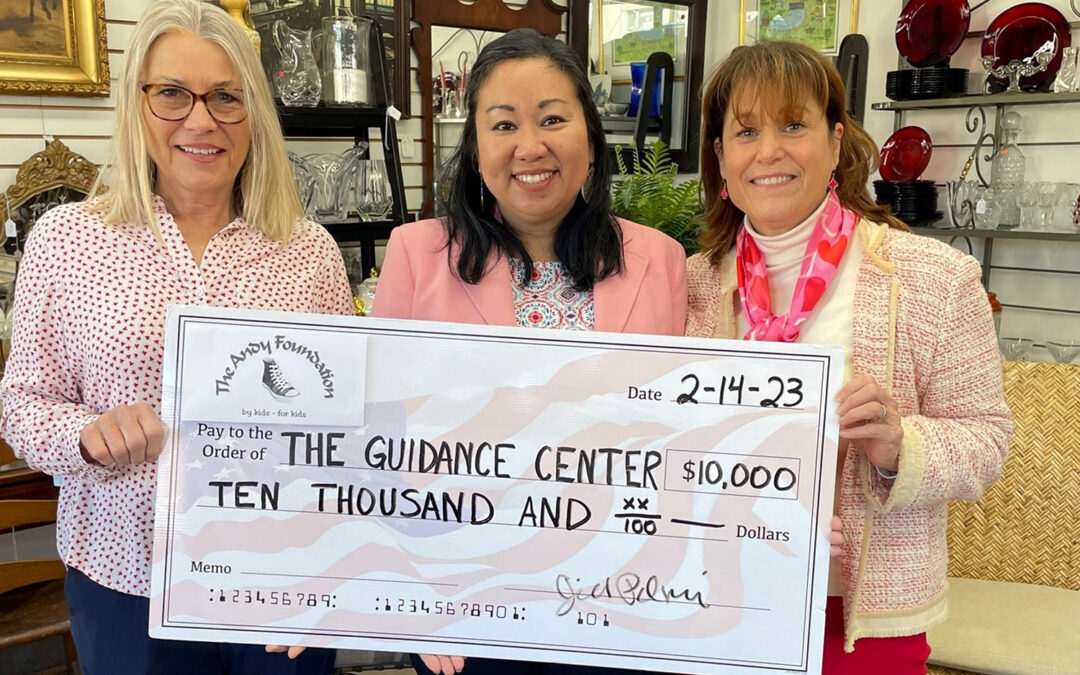
North Shore Child and Family Guidance Center, the leading not-for-profit children’s mental health agency on Long Island, is pleased to announce that The Andy Foundation, a Garden City-based nonprofit, dedicated to helping children less fortunate than most, has donated $10,000 to support its mission.
“There is such a tremendous need now for supporting mental health services for young people, especially since the pandemic caused such isolation, fear and sadness,” said Jill Palmeri, the founder of The Andy Foundation. “Our mission is helping children in need, and the lifesaving work of the Guidance Center is something we are proud to support.”
Kathy Rivera, executive director/CEO of the Guidance Center, expressed gratitude for The Andy Foundation’s generous donation.
“We never turn anyone away for inability to pay, so we count on the support of the local community, foundations and other funding sources to make sure we are here for everyone who needs us,” Rivera said. “Kids and teens are experiencing rates of depression, anxiety and suicidal thinking at levels that are higher than ever before, and because of caring people like Jill and her team, these young people will get the help they desperately need and deserve.”
The Andy Foundation, which was formed in 2004 to honor the memory of Andrew Palmeri, focuses on helping children less fortunate than most. If you would like to support The foundation you can do so by donating or shopping at The Andy Foundation Yard Sale Shop, located at 195 Herricks Road, Garden City Park. The store is filled with vintage and gently used items and it is staffed by a team of dedicated volunteers. All proceeds from the store go to furthering the mission of The Andy Foundation.
The Guidance Center, which is celebrating its 70th anniversary this year and has offices in Roslyn Heights, Manhasset and Westbury, is dedicated to restoring and strengthening the emotional well-being of children (from birth to age 24) and their families. The organization’s highly trained staff of psychiatrists, psychologists, social workers and other mental health professionals lead the way in diagnosis, treatment, prevention and advocacy. The Guidance Center helps children and families address issues such as depression and anxiety; suicidal thinking; developmental delays; bullying; teen pregnancy; sexual abuse; drug and alcohol use; trauma; and family crises stemming from illness, death and divorce.
For more information on the Andy Foundation, visit www.theandyfoundation.org or email info@theandyfoundation.org. To learn more about the Guidance Center, visit www.northshorechildguidance.org or call 516-626-1971.
by North Shore Child & Family Guidance Center | Mar 10, 2023 | Blank Slate Media, In The Media
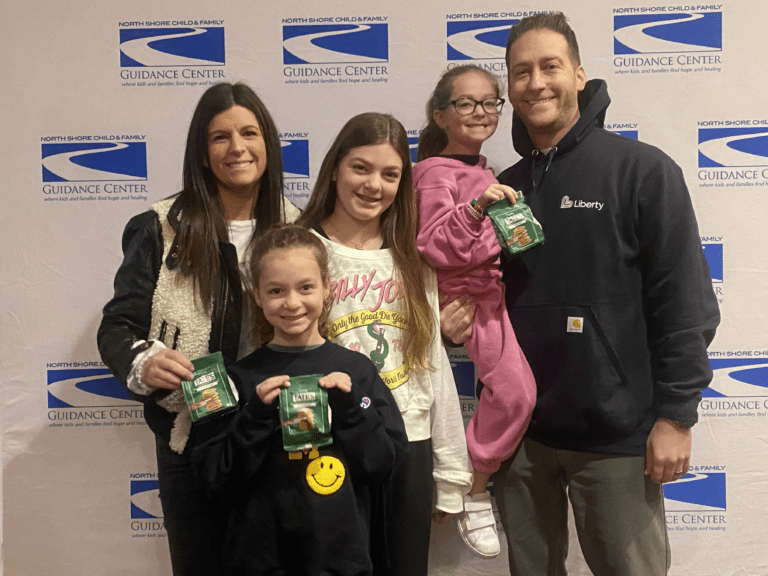
North Shore Child and Family Guidance Center’s family-friendly fundraiser at Manhasset Cinemas was a big hit with kids and parents alike. “Morning Movies with the Guidance Center,” which was held on Feb. 11, featured three film choices – The Amazing Maurice, 80 for Brady and Minions – and everyone enjoyed bagels, popcorn and drinks.
“We all know that children and teens are experiencing issues like depression, anxiety and even suicidal thinking more than ever before, and that’s why I’m proud to support the Guidance Center’s lifesaving work,” said Jeffrey Greenblatt, one of the event’s co-chairs and a Guidance Center board member. “Plus, my family had a wonderful morning, and I’m sure we’ll be back next year for this new tradition.”
Co-chair Joshua D. Brookstein, who also brought his family to the fundraiser, said, “There is nothing more important than the well-being of our kids. It is an honor to help the Guidance Center bring hope and healing to our communities.”
Kathy Rivera, executive director and CEO of the Guidance Center, thanked all who came out, along with the event’s sponsors: Liberty Utilities, Sahn Ward Braff Koblenz PLLC, Americana Manhasset, PSEG LI, Harris Beach PLLC, Cullen and Dykman LLP, the Marcell Family and the Slade Family, as well as Manhasset Cinemas, Tate’s Bake Shop and Bagel Boss of Roslyn.
“The Guidance Center team works hard each and every day to serve the families of Nassau County,” Rivera said. “We couldn’t succeed without the support of the community, our donors and the generous companies who partner with us.”
To learn more about North Shore Child & Family Guidance Center, visit www.northshorechildguidance.org.
by North Shore Child & Family Guidance Center | Mar 7, 2023 | In The Media
North Shore Child & Family Guidance Center (the Guidance Center), the leading not-for-profit children’s mental health agency on Long Island, is pleased to announce that The Andy Foundation, a Garden City-based nonprofit, dedicated to helping children less fortunate than most, has donated $10,000 to support its mission.
“There is such a tremendous need now for supporting mental health services for young people, especially since the pandemic caused such isolation, fear and sadness,” said Jill Palmeri, the founder of The Andy Foundation. “Our mission is helping children in need, the lifesaving work of the Guidance Center is something we are proud to support.
Kathy Rivera, Executive Director/CEO of the Guidance Center, expressed gratitude for the Andy Foundation’s generous donation. “We never turn anyone away for inability to pay, so we count on the support of the local community, foundations and other funding sources to make sure we are here for everyone who needs us,” said Rivera. “Kids and teens are experiencing rates of depression, anxiety and suicidal thinking at rates that are higher than ever before, and because of caring people like Jill and her team, these young people will get the help they desperately need and deserve.”
The Andy Foundation, which was formed in 2004 to honor the memory of Andrew Palmeri ,focuses on helping children less fortunate than most. If you would like to support The Foundation you can do so by donating or shopping at The Andy Foundation Yard Sale Shop , located at 195 Herricks Rd, Garden City Park. The store is filled with vintage and gently used items and it is staffed by a team of dedicated volunteers. All proceeds from the store go to furthering the mission of The Andy Foundation.
Photo: Left to Right: Andy Foundation founder Jill Palmeri, Kathy Rivera and Lauren McGowan
by North Shore Child & Family Guidance Center | Mar 1, 2023 | In The Media, Press Releases
Roslyn Heights, NY, March 1, 2023 —North Shore Child & Family Guidance Center (the Guidance Center), the leading not-for-profit children’s mental health agency on Long Island, is pleased to announce that The Andy Foundation, a Garden City-based nonprofit, dedicated to helping children less fortunate than most, has donated $10,000 to support its mission.
“There is such a tremendous need now for supporting mental health services for young people, especially since the pandemic caused such isolation, fear and sadness,” said Jill Palmeri, the founder of The Andy Foundation. “Our mission is helping children in need, and the lifesaving work of the Guidance Center is something we are proud to support.”
Kathy Rivera, Executive Director/CEO of the Guidance Center, expressed gratitude for The Andy Foundation’s generous donation. “We never turn anyone away for inability to pay, so we count on the support of the local community, foundations and other funding sources to make sure we are here for everyone who needs us,” said Rivera. “Kids and teens are experiencing rates of depression, anxiety and suicidal thinking at levels that are higher than ever before, and because of caring people like Jill and her team, these young people will get the help they desperately need and deserve.”
The Andy Foundation, which was formed in 2004 to honor the memory of Andrew Palmeri ,focuses on helping children less fortunate than most. If you would like to support The Foundation you can do so by donating or shopping at The Andy Foundation Yard Sale Shop , located at 195 Herricks Rd, Garden City Park. The store is filled with vintage and gently used items and it is staffed by a team of dedicated volunteers. All proceeds from the store go to furthering the mission of The Andy Foundation.
The Guidance Center, which is celebrating its 70th anniversary this year and has offices in Roslyn Heights, Manhasset and Westbury, is dedicated to restoring and strengthening the emotional well-being of children (from birth – age 24) and their families. The organization’s highly trained staff of psychiatrists, psychologists, social workers and other mental health professionals lead the way in diagnosis, treatment, prevention and advocacy. The Guidance Center helps children and families address issues such as depression and anxiety; suicidal thinking; developmental delays; bullying; teen pregnancy; sexual abuse; drug and alcohol use; trauma; and family crises stemming from illness, death and divorce.
Photo: Left to Right: Andy Foundation founder Jill Palmeri, Kathy Rivera and Lauren McGowan
by North Shore Child & Family Guidance Center | Feb 24, 2023 | CBS News TV, In The Media

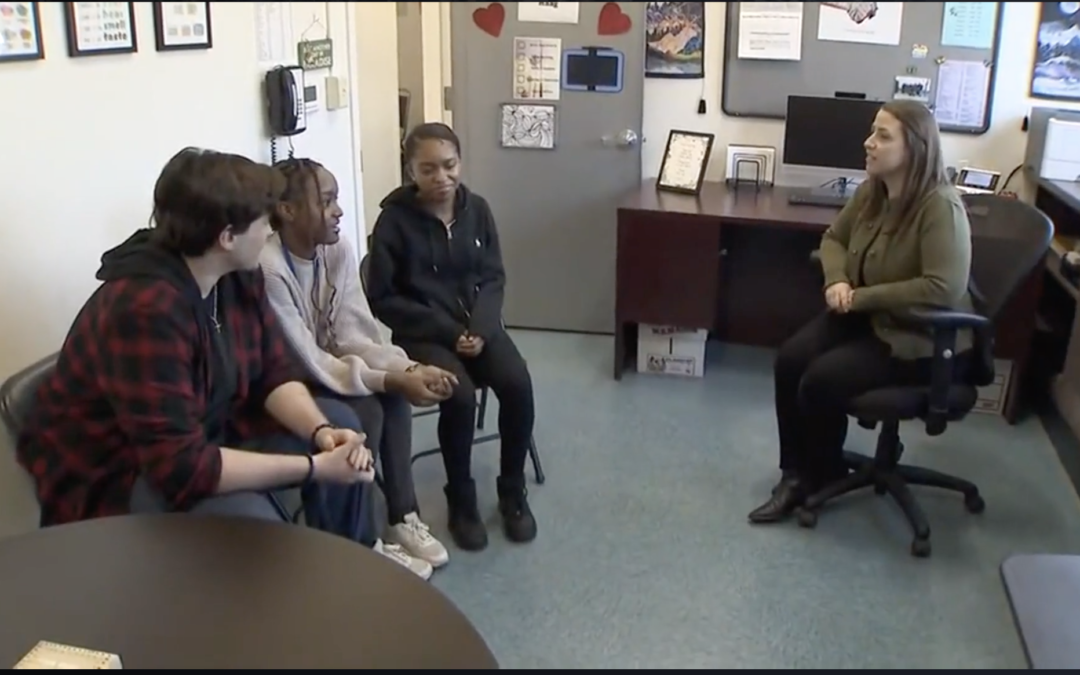
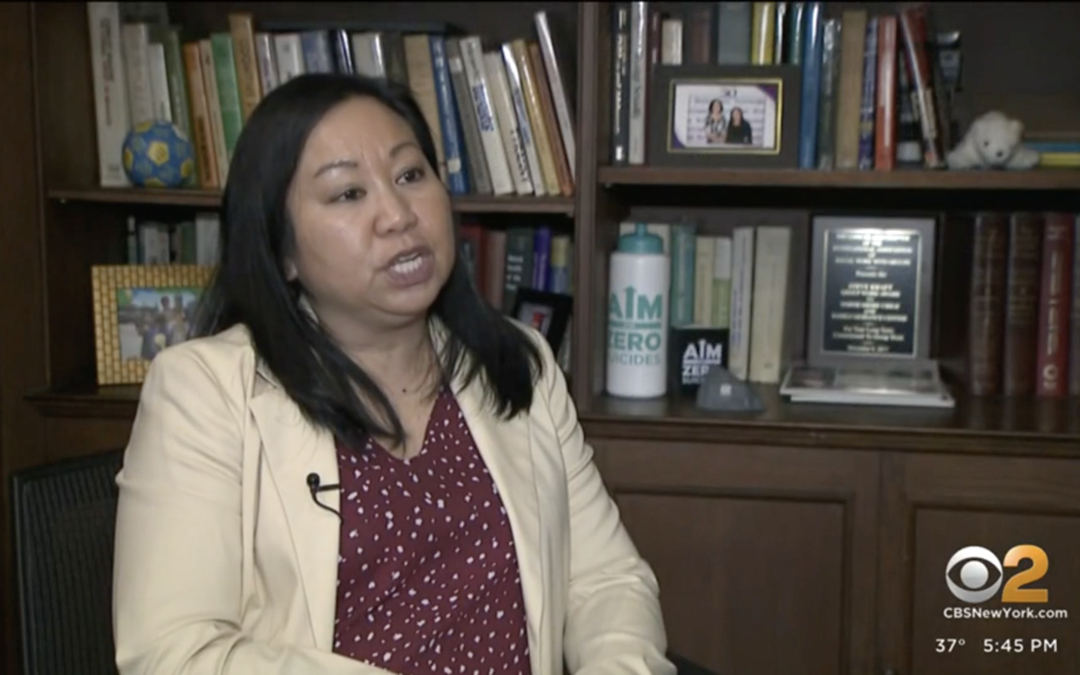
“Nonprofits, Schools Stepping Up to Assist Children in Need of Mental Health Help,” CBS New York News, February 23, 2023

by North Shore Child & Family Guidance Center | Feb 19, 2023 | In The Media, Newsday
Nearly 3 in 5 teenage girls felt persistent sadness in 2021, while 1 in 3 seriously considered attempting suicide, according to a new CDC report that experts said mirrored trends on Long Island.
The survey of 17,000 teenagers across the country by the U.S. Centers for Disease Control and Prevention found that the feelings of sadness among girls was double that of boys.
The CDC conducts the survey every two years, and said rates of mental health problems among young people have gone up with every report since 2011.
Experts on Long Island attributed that to various factors including the pandemic, but some focused on the rise of the smartphone and the constant access it gives children to social media.
Dr. Victor Fornari, the vice chair of child and adolescent psychiatry for Northwell Health, said the declining mental health of teenagers and younger children parallels the widespread use of smartphones.
“We really do see an association timewise with the smartphone in every teenager’s hand in the past decade and the dramatic increase in this degree of depression and suicidal ideation amongst youth,” he told Newsday.
At Long Island Jewish Medical Center in New Hyde Park, where he practices, the number of adolescents coming to the emergency room for suicidal thoughts or attempts has soared in the past four decades, he said.
In 1982 the figure was 250. By 2010, it increased to 3,000. By 2022, it was about 8,000, he said.
Experts also cited other causes of the deteriorating mental health of young people, including pandemic-era isolation, the pressures of re-entry to “normal” life at school, growing drug use, fear of mass shootings, and a lack of therapists and mental health counselors.
Kathleen Ethier, director of CDC’s adolescent and school health division, said that in 30 years of collecting similar data, “we’ve never seen this kind of devastating, consistent findings. There’s no question young people are telling us they are in crisis. The data really call on us to act.”
Jeffrey Friedman, CEO of the nonprofit Central Nassau Guidance & Counseling Services in Hicksville, said his agency has seen an increase in young people and especially girls coming to them for help during the pandemic.
He said that by the time they arrive, many are “very close to the end of their rope” because it is so difficult for their parents to find mental health counselors.
“It’s really hard to navigate the mental health system,” he said. “So when you need to find a child psychiatrist on Long Island, it’s almost impossible. There are very few, and many don’t take insurance. And so parents and families feel alone, that there’s no help out there.”
Monique Barragan, a licensed mental health counselor at the North Shore Child & Family Guidance Center in Nassau County, said the pandemic increased isolation and anxiety among young people. But transitioning back to regular classes has also created mental health challenges.
“It’s almost like a shock,” she said. When they were under lockdown at home, “they didn’t really have to think about other people judging them.”
The nonprofit Family Service League, which works mainly in Suffolk County, said it responded to seven suicides of young people and young adults in 2022, and to four already this year.
The number of school districts requesting anti-suicide programs increased from three in 2021 to six in 2022, said Kathy Rosenthal, the group’s senior vice president.
Fornari, of Northwell, said society needs to find a way to prevent smartphones from undermining children’s mental health.
“How many times an hour do they check their texts, their emails, and WhatsApp, their social media sites?” he said.
“In conversations with kids you’ll hear about all of the ways in which they feel slighted, insulted, angry, attacked by being excluded from an event, or betrayed by a friend,” he said. “It goes on all day long to the point in which they are so distracted that they can’t even focus on anything else.”
“There are clearly many advantages and many benefits from social media but there is also a dark side,” he said, “and I think the mental health crisis in youths is part of the dark side.”
WHAT TO KNOW
- Nearly 3 in 5 teenage girlsfelt persistent sadness in 2021, while 1 in 3 seriously considered attempting suicide, a new CDC survey says.
- Experts said that mirrored trendson Long Island, where they say finding mental health counselors is extremely difficult.
- One expert blamed smartphones and social media for much of the distress young people are feeling.

by North Shore Child & Family Guidance Center | Feb 10, 2023 | Anton Media, In The Media
By Dr. Nellie-Taylor Walthrust
Getting a driver’s license is a rite of passage that teenagers have been celebrating since the early days of automobiles. Driving makes teens feel more independent than ever before, and it can also provide a break for parents, who spend a great deal of their time carting their kids back and forth from practices and other activities.
But the celebration of this newfound freedom necessitates a crucial conversation and the drawing of a line in the sand: Let them know that driving while using alcohol, marijuana or any other substances is forbidden, and start having these conversations when they are young.
With marijuana use now legal for people 21 years of age and older, your kids may be of the mindset that it’s not a big deal. That’s far from the truth. It’s illegal to drive while under the influence of alcohol and weed or other drugs. According to the NY State Governor’s Traffic Safety Committee, driving under the influence of marijuana subjects you to the same penalties as driving under the influence of alcohol.
And there’s good reason: Marijuana impacts areas of the brain that control perception, balance, coordination, memory and judgment. It can slow reaction times, decrease attention and make it difficult to follow the road and stay in your lane.
We know you don’t want your kids to use marijuana or alcohol, period. But the reality is that many of them do. Having the conversation about safety and driving will not make them any more likely to experiment – in fact, it might have the opposite effect.
Here are some sobering statistics:
- 23% of teens admit they have driven under the influence of alcohol, prescription drugs or marijuana.
- Teen drivers 16-19 have a fatal crash rate almost three times as high as drivers ages 20 and older.
- The percent of crash deaths involving cannabis more than doubled from 9% in 2000 to 21.5% in 2018.
- 24% of teens reported that within the previous month, they had been a passenger in a car with a driver who had been drinking alcohol or using drugs.
As a parent, what can you do to minimize the risks?
The Centers for Disease Control and Prevention suggests creating a Parent-Teen Driving Agreement that clearly sets expectations and limits. Sit with your teen and write down the hazards of driving while impaired and the consequences for breaking the rules. Put it on your refrigerator and update it as your teen gains experience and more driving privileges. (Visit cdc.gov for a sample agreement.)
If your teen plans to go to a party, make sure you talk to the parents where the festivities are being held. Ask if there will be supervision and if alcohol is being served—and if your teens are under 21, the answer should be a resounding no.
Despite taking all precautions, your teens may find themselves in a situation where they are being pressured to drink or use drugs. Tell them that you will be willing and able to get them at any time during the night—and that if they or their friends have been drinking or using drugs, they should contact you for a ride.
As parents, we must do all we can to educate our kids about the dangers of driving while impaired, but we also need to face the reality that even “good” kids can start heading down a dangerous path. Keep the lines of communication open, and if you suspect there may be a problem, consider contacting a professional who is trained in alcohol and substance use.
Bottom line: Let your teen know that driving requires their full attention, so marijuana, alcohol or any kind of substances are not allowed – and that means no texting, too!
 Dr. Nellie Taylor-Walthrust is the Director of at North Shore Child & Family Guidance Center’s Leeds Place, which operates an Adolescent Outpatient Chemical Dependency Treatment Program. Substance use services include counseling youths who are alcohol and drug abusers, children who live in families with a parent who is suffering from alcoholism or drug addiction and youths who have co-occurring chemical dependency and mental health problems. Prevention services are offered to local school districts. Call (516) 626-1971 to learn more.
Photo credit (for the driving photo): Adobe Stock, By Habitante Stock

by North Shore Child & Family Guidance Center | Jan 30, 2023 | In The Media, Newsday
By Beth Whitehouse, Newsday.com, January 25, 2023
From obstacle courses to cooking classes to horseback riding, several Long Island groups offer extracurricular activities that help children on the autism spectrum feel more at ease while they’re having fun.
The activities may provide higher staff ratios or have directions and processes broken down into parts to help out participants, organizers say, and the age range goes from toddlers all the way into the teen years.
Here are some places that offer fun recreational options geared toward kids with special needs:
Cecelia Cernilli, 6, from Rockaway, participates in a sensory activity with her dad Matt Cernilli at Actions Speak yoga class at Positions Dance Studio in Babylon on Jan. 8. Credit: Morgan Campbell
A speech language pathologist and an occupational therapist run three activities for children of different ages. Yes I Can is an obstacle-course challenge for children ages 5 to 8; it’s a class of eight to 10 children with a lot of structure, consistency and routine, says Lauren Vaughan, an occupational therapist.
Yoga and You is a preschool option during which children learn emotional regulation; siblings who are not on the spectrum are welcome to attend as well. Tiny Titans is for ages 18 months to 3 years who need work on language development skills and calming strategies even though they might not yet have an official diagnosis of autism, says Frieda Shmuel-Markowitz, the speech language pathologist.
Classes are held at Positions Dance Studio, 264 Deer Park Ave., Babylon, on Sunday mornings or New York Dancers Studio, 388 Merrick Ave., East Meadow, on Thursday evenings. A full six-week series is $185 and includes a 20-minute Zoom consultation with the parents prior to the course; a three-week series is $100 and individual classes are $40. For more information or to register, call 516-305-7227 or visit actionsspeakkids.com.
The Family Center for Autism, 1517 Franklin Ave., Garden City
At The Family Center for Autism, children, tweens and teens can participate in programs including yoga, Zumba, music, cooking classes and more, says Tina Moreno, director of development. The center particularly has focused on the needs of high school students ages 14 to 18, Moreno says.
“We felt that was the black hole, they just fell through the cracks. They weren’t getting invited to parties, they weren’t going to hang out on a Friday night,” she says.
The center’s weekly Friday Night Social Scene from 5:30 to 8:30 p.m. is a very popular offering, during which participants do arts and crafts, play video games and make friends, says Lonnell Harrington, assistant director. For more information and pricing, which varies, call 516-355-9400 or visit familycenterforautism.com.
Participants study a different artist every week at during the Spirit of Huntington Arts Center’s drop-in ArtABILITY classes for ages 5 to 17, which include a slideshow of the artists’ art, perhaps a video clip of the artist working, and an art project in the style of the artist, says Michael Kitakis, executive director. All of the students’ creations may be included at a periodic art exhibit, he says.
Classes are in person from 10:30 to noon on Saturdays; a virtual option allows students to take the class at 12:30 p.m. Saturdays, with boxes of material sent to their homes in advance. Classes are $75 each.
The center also offers a six-week series of clay classes during which students make cups, bowls, decorations and more, with advanced students about to use pottery wheels; cost is $250 plus a $40 fee for the clay. A Clay Partners class at 11:30 a.m. Saturdays allows ages 5 and older to collaborate on projects with a parent for the same fee that includes both participants. For more information, call 631-470-9620 or visit spiritofhuntington.com.
HorseAbility, on the campus of SUNY Old Westbury, 223 Storehill Rd.
HorseAbility’s adaptive riding program offers group or private lessons adapted to the needs of the individual. Lessons are 30 or 45 minutes and are geared to offering physical, mental and social rewards, including interacting with the animals and the volunteers, says Katie McGowan, founder and executive director. For ages 4 and older. Cost is $55 per group lesson and $90 per private lesson, but lessons are offered as a series. For more information, call 516-333-6151 or visit horseability.org.
Long Island Children’s Museum, 11 Davis Ave., Garden City
Once a month, the Long Island Children’s Museum opens after hours for families with children on the spectrum or with other special needs; admission is free for the whole family once families preregister on the museum website, says Maureen Mangan, director of communications. During Friendly Hours the museum lighting and sound is reduced. The next session is from 6 to 8 p.m. on Feb. 24. For more information, call 516-224-5800 or visit licm.org.
These programs are designed for family members of children with special needs:
GASAK — Grandparent Advocates Supporting Autistic Kids, The North Shore Child and Family Guidance Center, 80 North Service Rd., Manhasset
The North Shore Child and Family Guidance Center offers a free monthly support group for grandparents who have grandchildren on the spectrum; it meets in person or on Zoom at 10:30 a.m. on the last Thursday of every month. “The grandparents … help each other, give each other ideas and suggestions. It’s a place they can share their fears and their little victories,” says facilitator Sue Cohen. Their friends who have typical grandchildren might not understand what a big deal it is when they express pride in their grandchildren’s accomplishments, Cohen says. For information, call 516-484-3174 ext. 402 or visit northshorechildguidance.org.
Sibshops siblings support group, Sensory Beans, 3309 Merrick Rd., Wantagh
Children ages 5 to 9 who have siblings with special needs can share their experiences — both good and challenging — with other kids who can relate during the monthly Sibshops gathering. Meetings include play, pizza and a drink and cost $30 per child. For more information, call 516-308-1462 or visit sensorybeans.org.
by North Shore Child & Family Guidance Center | Jan 18, 2023 | In The Media
“Wellness in the Home,” a webinar for Hicksville Public Schools featuring Kathy Rivera, North Shore Child & Family Guidance Center Executive Director/CEO.

by North Shore Child & Family Guidance Center | Jan 18, 2023 | Anton Media, Blog, In The Media
By Kathy Rivera
This column appeared in January 11, 2023 issue of Anton Media newspapers
All of us have experienced unprecedented challenges in the last three years, resulting in heightened levels of anxiety and stress. So much is out of our control, and that can feel overwhelming. But there are steps you can take to safeguard your wellbeing and that of your family.
As you welcome in 2023, take the opportunity to put into place some of these eight resolutions to start the New Year off right.
- Tune in and turn off: Sure, your kids need to be told to put the phones away at the dinner table and when they’re doing homework. But they’re not the only ones who overuse the tech gadgets. When you are with your kids, be fully present. The years really do fly by.
- Be a role model: Believe it or not, your children and teens look to you as their example of how to act in the world. For your sake and theirs, eat healthfully and exercise, spend more time outdoors, and be sure to…
- Put self-care in your list of priorities: As parents, we sometimes think our job is to sacrifice ourselves for the sake of our children. But if you don’t take care of yourself, you’ll have nothing left to give them. Take the time to engage in activities that make you feel happy, confident and healthy.
- Don’t compare yourself to other parents or your kids to other kids: Facebook and other social media platforms make it look like every parent has the perfect child—the honor student, star athlete, community volunteer, etc. But these are just self-selected pieces of information and don’t paint a true picture. Every parent faces challenges, and no one is perfect.
- Don’t take the bait: Kids push our buttons, there’s no doubt about it. But when you respond to your tot’s tantrum with a tantrum of your own, it doesn’t help the situation and only creates more chaos. When they are acting up, take a deep breath and remember that the goal is to respond thoughtfully, not react impulsively. One way to hone this skill is to…
- Practice meditation. Numerous studies show that even a few minutes a day of meditation will help reduce your stress. Not sure how? Google “how to meditate” and you’ll find lots of helpful tips and videos. You can also google “meditation on Long Island” to find a group. And invite your kids to try it out, too! Let them know supercool celebrities and athletes like Selena Gomez, Lady Gaga, Lizzo, Derek Jeter and LeBron James are big meditators.
- Listen closely and talk less: When our children come to us with problems, it’s our natural inclination to try to fix things for them. But the reality is, often what they need is just to be heard. Make a promise to yourself that you will listen to your kids and not jump in right away to solve the problem. To open the lines of communication, simply ask, How are you feeling?
- Pay attention and give praise: The way you communicate with your child not only teaches them how to communicate with others, it shapes their emotional development and how they build relationships later in life. Giving your child positive attention for good behavior can boost their self-esteem, improve your relationship and help your child understand the behaviors you like and want to see more often.
Wishing you and your family a happy, healthy and peaceful New Year!
Bio: Kathy Rivera, LCSW, the Executive Director/CEO of North Shore Child & Family Guidance Center, Long Island’s leading non-profit children’s mental health organization. To get help for your child or to support the Guidance Center’s lifesaving work, call (516) 626-1971 or visit www.northshorechildguidance.org.
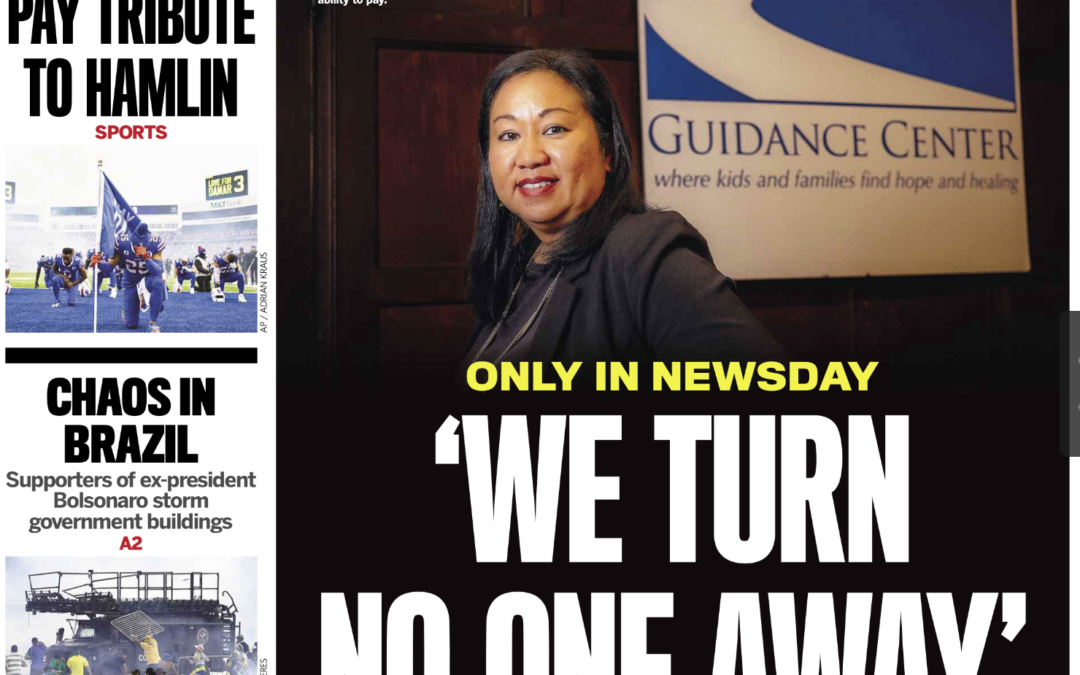
by North Shore Child & Family Guidance Center | Jan 6, 2023 | In The Media, Newsday
Newsday, By Bart Jones
Nonprofits on Long Island say they are offering affordable mental health therapy for teens and young children — without long waiting lists — as the region faces a shortage of psychologists serving those age groups.
Many families in Nassau and Suffolk counties have grown frustrated trying to find private therapists, who often don’t take insurance and have waiting lists months long — or no available appointments at all.
The nonprofits are encouraging parents to contact them at a time when depression, anxiety and suicide rates among young people are rising due to a confluence of factors including isolation during the COVID-19 pandemic and heavy social media use.
“Right now, we have capacity to take on cases,” said Kathy Rivera, executive director and CEO of North Shore Child & Family Guidance Center, with offices in Manhasset, Roslyn Heights and Westbury.
“We turn no one away for any inability to pay,” she said. “We are grassroots, and we are committed to equity in mental health regardless of what your ZIP code is, what your bank account looks like. Everyone deserves to have access to care.”
The agency has 50 therapists on staff, along with other workers and a department that deals solely with insurance companies, she said.
Nonprofits such as North Shore said they can help fill a gap as families struggle to find therapists for their children. Some parents are taking their kids to private therapist appointments during school hours — the only time slots available — while others are getting saddled with thousands of dollars in bills because their therapists don’t take insurance, experts said.
Meanwhile, the number of people between the ages of 12 and 17 nationwide who experienced at least one major depressive episode increased by 306,000, or 1.4%, year-over-year, according to an October 2021 report from the Mental Health America nonprofit. At the same time, nearly 61% of New York youths with major depressive episodes did not receive treatment, the report said.
Finding trusted therapists
Adrienne LoPresti, executive director of YES Community Counseling Center in Massapequa, said her nonprofit also generally has capacity to provide therapists for young people in a timely manner.
“There is a comprehensive system of care for youth and families, which includes YES, that provides affordable services regardless of income and health insurance status,” LoPresti said. “Unfortunately, many community members are unaware of these networks and resources.”
LoPresti cautioned that families should make sure they connect with reputable agencies, since there is a proliferation of people offering “telehealth” appointments who are not always qualified.
“It’s important to find access to a vetted mental health provider you trust in your community,” she said. Local schools, ones that have their own psychologists and social workers, can help identify reputable therapists, she added.
While telehealth services offer some advantages, “it is often the financial gains rather than quality care” that is the priority, she said. In-person counseling is generally more effective than on-screen, she added.
Besides YES and North Shore, agencies families can contact to help find a community-based therapist include the Nassau County Helpline, at 516-227-TALK (or 8255), and the Long Island Crisis Center‘s 24/7 hotline, at 516-679-1111, LoPresti and Rivera said.
Central Nassau Guidance and Counseling Services based in Hicksville also has therapists available, and works with families on a sliding scale if they have financial difficulties, CEO Jeffrey Friedman said.
Adapting to diversity
Some agencies are seeking to adapt to Long Island’s increasingly diverse population.
North Shore Child & Family Guidance Center has intake staff who speak fluent Spanish and other staff members who can translate Creole and Arabic, Rivera said.
Another agency, the Hispanic Counseling Center, with offices in Hempstead and Bay Shore, focuses on Latino children, youth and adults. Its Mental Health Clinic offers bilingual and bicultural mental health counseling, and refuses services to no one, CEO Claudia Boyle said.
In response to the growing demand, the group is boosting its efforts to hire more therapists, she said.
In Suffolk County, the nonprofit Rise Life Services in Riverhead opened a mental health clinic in November 2021 that includes treatment for children after it saw a growing demand for therapists for that age group, said Tracey Anderson, operations director of clinical services and behavioral health.
Their anticipation of “a high demand for mental health services for youth was certainly on point,” she said. “The demand is even higher than we expected. “
The nonprofit Family Service League, which works throughout Suffolk County, has seen the need for more therapists first hand and through its DASH hotline helps families connect with them, said Kathy Rosenthal, senior vice president at the group.
“We are finding youth with higher rates of anxiety, depression and other mental health challenges, and, tragically, an increase in young people attempting and dying by suicide, she said.
The number of teenage suicides her group responded to in Suffolk tripled between 2020 and 2021, going from four to 12, she said.
Families can contact FSL’s hotline DASH at 631-952-3333. They can also contact the Suffolk County Response Crisis Center at 631-751-7500 for help in finding a therapist.
Groups representing private therapists said families should not give up on seeking their help. The Suffolk County Psychological Association‘s website allows families to plug in their hometowns, insurance and other information to try to match them with a therapist, said Ann Eckardt Erlanger, past president of the group. The Nassau County Psychological Association has a similar website mechanism.
Rivera also said families should keep trying to get their children help, despite the obstacles.
“There is hope and an opportunity for healing,” she said.
WHAT TO KNOW
- Families in Nassau and Suffolk say they have become frustrated while seeking private therapists who often won’t take insurance and have wait-lists or no available appointments.
- Long Island nonprofits say they offer affordable mental health therapy for teens and young children — without long wait-lists.
The nonprofits are encouraging parents to contact them at a time when depression, anxiety and suicide rates among young people have climbed because of the pandemic and heavy social media use.
by North Shore Child & Family Guidance Center | Jan 6, 2023 | CBS News TV, In The Media

by North Shore Child & Family Guidance Center | Jan 4, 2023 | Blog, In The Media, Newsday
Newsday, January 4, 2023
Thank you for highlighting the crisis in access to mental health services among our youth as rates of depression, anxiety and suicidal thinking are at all-time highs in your cover story of December 27, 2022.
While the pandemic has exacerbated the struggles of children and teens, the difficulty in finding timely and affordable quality mental health care isn’t new. In 2017, North Shore Child & Family Guidance Center conducted extensive research, spotlighted in our Project Access report, shining a light on the longstanding problem and advocating for strategies to effect change.
Throughout our 70-year history, we have been providing mental health services to the children and families of Nassau County within just days of receiving their call, and no one is ever turned away for inability to pay. Kids in crisis can’t wait weeks or months for help.
Kathy Rivera
Executive Director/CEO
North Shore Child & Family Guidance Center
Roslyn Heights, NY
